Margherita Pizza: Ingredients and Technique
Four toppings and nowhere to hide: how to get the tomato, fresh mozzarella, basil and heat right for a 12-inch margherita in a home or outdoor oven.
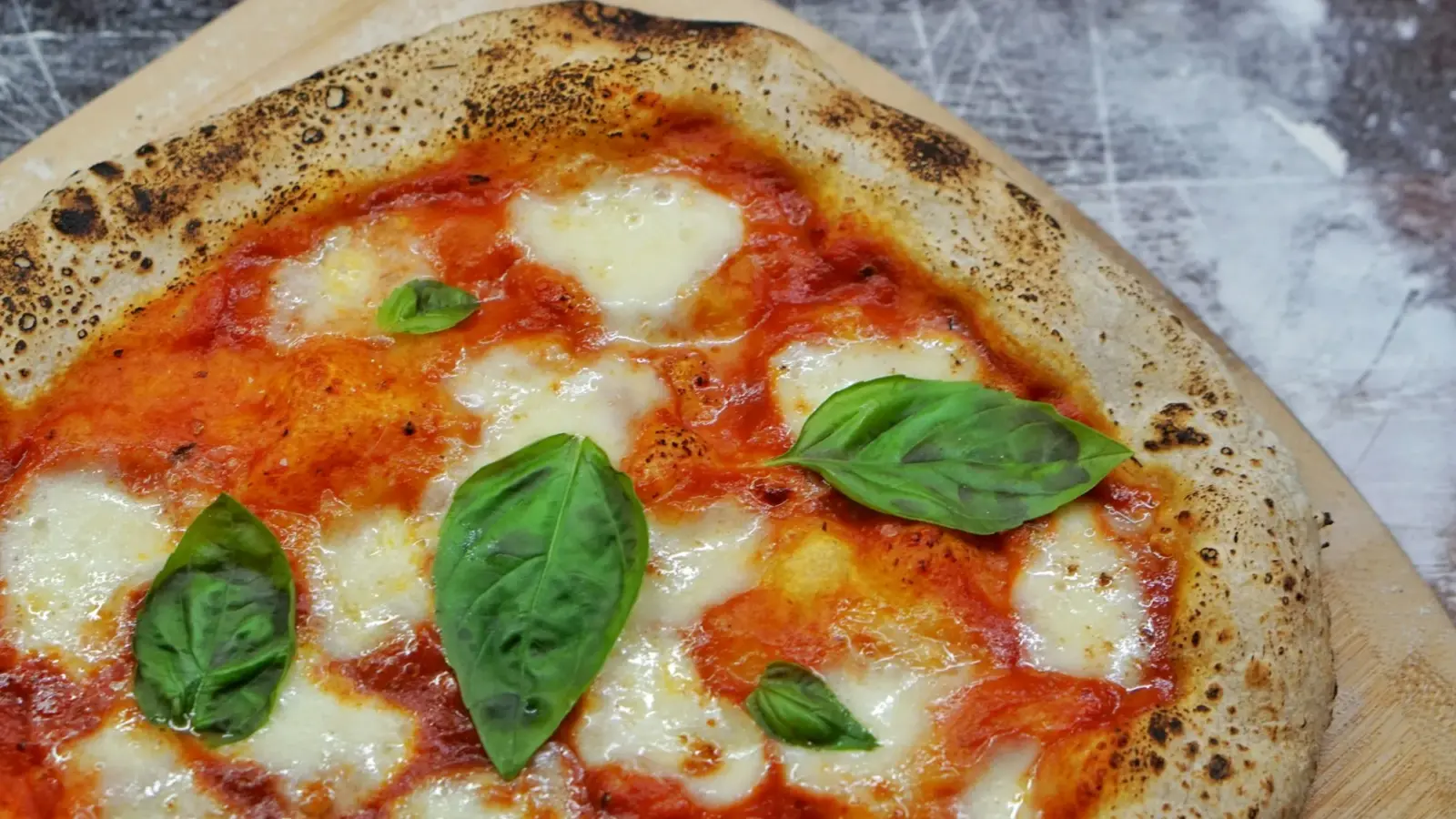
A great margherita at home comes down to three moves: dry the fresh mozzarella, get the heat as high as it will go and time the basil. Do that, and a home oven with a steel and the broiler bakes a puffy, spotted 12-inch pie in about five minutes; an outdoor pizza oven near 800°F (425°C) does it in about 90 seconds.
Each of the four toppings has a job. Raw tomato brings brightness, mozzarella milky richness and basil perfume, while extra-virgin olive oil ties them together. The recipe below makes one pizza on a 00-flour dough that works in either oven, plus a New York-dough shortcut if you are baking indoors.
What makes a margherita a margherita
Naples has written this pizza down. The EU’s Traditional Speciality Guaranteed specification for Pizza Napoletana, registered in 2010, tops a pie no wider than 35 cm (about 14 inches) with 60 to 80 g of crushed peeled tomatoes, salt, 80 to 100 g of sliced mozzarella, several basil leaves and 4 to 5 g of extra-virgin olive oil. The rules of the Associazione Verace Pizza Napoletana (AVPN), which certifies pizzerias, accept buffalo mozzarella or fior di latte, the cow’s-milk version, and make a little grated hard cheese optional.
Those amounts are the point: a thin, bright layer of tomato rather than a blanket of sauce, and cheese in patches with red showing between them. The card uses 80 g of tomatoes and 100 g of cheese for a 12-inch (30 cm) pie.
Use canned whole peeled tomatoes, drained and crushed by hand. The AVPN salts the tomatoes rather than the stretched dough, at 10 to 12 g per kilogram, or 7 to 10 g for San Marzanos, which its rules call already tastier. For 80 g, that is a pinch. The tomato goes on raw. Our no-cook pizza sauce works too if you skip the oregano.
The 1889 story, and why historians doubt it
The legend: in June 1889, while Queen Margherita of Savoy was in Naples with King Umberto I, the pizzaiolo Raffaele Esposito made three pizzas for her. She favored the one in the colors of the Italian flag (red tomato, white mozzarella, green basil), and it took her name. Pizzeria Brandi, the shop where Esposito worked, still keeps a thank-you letter dated June 1889 and signed by Galli Camillo, head of table services for the royal household.
Historians are less convinced. Zachary Nowak’s 2014 paper in Food, Culture & Society weighs the evidence and treats the tale as an invented tradition. The doubts run along three lines: the letter’s authenticity has been questioned, no newspaper of the time reported the royal pizza, and both the story and the name seem to have been promoted only in the 1930s and 1940s.
Even the EU specification hedges, dating the Margherita to “1796-1810” and saying only that it was presented to the queen in 1889. Francesco De Bourcard’s 1866 survey of Neapolitan customs already lists basil, thin slices of mozzarella and tomato among pizza toppings. Italy’s Casa Artusi notes a rival theory for the name, too: cheese slices arranged like the petals of a daisy, a margherita. The pizza is older than the legend, and the royal christening is at least partly a story told afterward.
Naples rules vs. a home oven
Under AVPN rules a margherita bakes in 60 to 90 seconds on an oven floor of about 380 to 430°C (715 to 805°F). Most home ovens stop at 500 to 550°F (260 to 290°C). Our guide to how New York and Neapolitan pizza differ covers the styles in full.
| Naples (AVPN) | Home oven, steel and broiler | Outdoor pizza oven | |
|---|---|---|---|
| Heat | Floor 380–430°C (715–805°F) | 500–550°F (260–290°C), broiler on high | Stone at 790–850°F (420–450°C) |
| Bake time | 60–90 seconds | 4–6 minutes | 60–90 seconds |
| Hydration | About 56–63% | 68% | 68% |
| Sugar | Never | 1.25%, for browning | None |
| Basil | Before baking | Under the cheese, or after baking | Before or after baking |
A wetter 00 dough
Home-oven Neapolitan-style recipes push the water up: America’s Test Kitchen’s Neapolitan-style pizza works out to about 76% hydration and King Arthur Baking’s to about 73%. A five-minute bake drives off far more moisture than a 90-second one, so a wetter start keeps the crumb tender. But as King Arthur’s Andrew Janjigian notes, a wet dough at home-oven heat also bakes longer, so this recipe settles at 68%, still easy to stretch by hand.
| Ingredient | Weight | Baker’s % |
|---|---|---|
| 00 pizza flour | 160 g | 100% |
| Water | 109 g | 68% |
| Salt | 4.5 g | 2.8% |
| Instant yeast | 0.4 g | 0.25% |
| Sugar (home oven only) | 2 g | 1.25% |
The AVPN bans sugar, but its pizzas never spend five minutes at 550°F. A little helps a lean dough brown in that time. ATK adds just under 1% and says to leave it out in a 650 to 700°F (345 to 370°C) pizza oven to prevent overbrowning. “00” describes how finely the flour is milled, and brands vary in protein and absorption; our comparison of bread flour and 00 flour for pizza explains what to look for.
Or use New York-style dough
A 280 g (10 oz) ball of our cold-fermented New York-style dough stretches to 12 inches and suits the home-oven method, giving a crisper, chewier crust. Keep it out of an 800°F oven, where its sugar overbrowns before the crumb is done.
Steel and broiler, or an outdoor oven
At home, the steel cooks the bottom and the broiler stands in for a wood oven’s dome. Set the steel 8 to 9 inches (20 to 23 cm) below the broiler, as King Arthur and ATK do, heat the oven to its maximum for an hour, then switch the broiler to high 5 to 10 minutes before launching. If the top darkens before the underside is spotty brown, turn the broiler off for the last minute or two, as ATK advises. Rack options and broiler quirks are in our guide to getting a crisp crust from a home oven.
An outdoor oven gets you close to the real thing. Ooni’s guidance for Neapolitan pizza is a stone preheated to 420 to 450°C (790 to 850°F); check the stone with an infrared thermometer. Give the pizza a quarter turn whenever the side nearest the flame blisters.
Draining fresh mozzarella
Wet cheese is the usual culprit behind a soupy margherita. Fresh mozzarella holds far more water than the low-moisture kind on a New York slice.
Tear it into rough 1-inch (2.5 cm) pieces, which drain faster than slices and melt into separate pools. Spread them on paper towels for at least 30 minutes and pat dry before topping; ATK’s recipe pats its torn mozzarella dry too. Leave gaps between pieces; the cheese spreads as it melts.
Tip: On a 4- to 6-minute broiler bake, drained cheese goes on with the tomato. If your bake runs past 8 minutes, on a stone without the broiler, add it halfway so it melts without separating.
Fior di latte is easier to find and more forgiving. Buffalo mozzarella is richer and wetter: drain it longer, or tear it over the pizza for the last minute or straight out of the oven. Our guide to mozzarella and other pizza cheeses compares them.
When to add the basil and oil
In Naples the basil goes on before baking, laid over the cheese, and wilts without burning in 90 seconds. The AVPN even allows tucking it under the mozzarella to keep it from scorching.
Five minutes under a broiler blackens exposed leaves. Tuck them under the cheese for a mellow, cooked flavor, or scatter fresh leaves over the pizza as it comes out, as ATK and King Arthur do, for a brighter one.
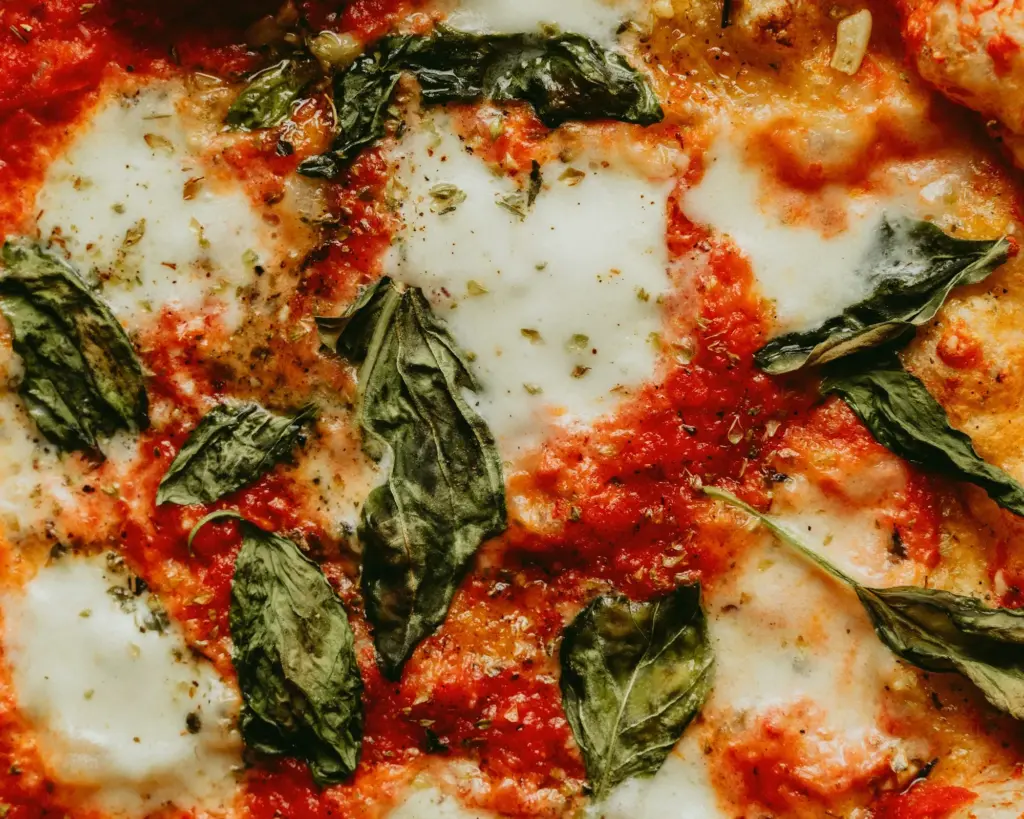
The AVPN wants the oil on before baking, where it blends with the tomato, and permits a raw drizzle afterward. The recipe does both.
Margherita Pizza
One 12-inch margherita on a 68%-hydration 00-flour dough, baked on a steel under the broiler or in an outdoor pizza oven.
- Prep
- 30 min
- Cook
- 6 min
- 15-minute rest, 1-hour rise, 24-hour cold ferment (up to 48 hours) and 2½-hour warm-up
- 1 day 4 hr
- Total
- 1 day 4 hr
- Yield
- One 12-inch (30 cm) pizza
- Serves
- 2
- Oven
- 500–550°F (260–290°C) with a pizza steel and broiler, or an outdoor pizza oven with the stone at 790–850°F (420–450°C)
Ingredients
Neapolitan-style dough
Or, for the home oven only
Topping
For shaping
Equipment
- Digital kitchen scale (0.1 g precision helps)
- Mixing bowl
- 1-quart (1 L) lidded container
- Pizza steel or baking stone
- Pizza peel
- Infrared thermometer (for an outdoor oven)
Instructions
- Mix the dough One to two days ahead, whisk the flour, salt, yeast and sugar (omit for an outdoor oven). Stir in the 75°F (24°C) water until no dry flour remains; cover and rest 15 minutes.
- Knead Knead with wet hands on an unfloured counter for 6 to 8 minutes, until smooth, elastic and only slightly tacky. Scrape it up as it sticks rather than adding flour.
- Ball and chill Shape a tight ball and set it in the oiled container. Leave it covered at room temperature 1 hour, then refrigerate at or below 40°F (4°C) for 24 to 48 hours.
- Warm the dough; prep the toppings Two to 3 hours before baking, set the dough on the counter until soft and slightly puffed. Tear the mozzarella into 1-inch (2.5 cm) pieces and drain on paper towels at least 30 minutes. Salt the crushed tomatoes.
- Preheat About 1 hour before baking, while the dough finishes warming: for a home oven, heat a steel 8 to 9 inches (20 to 23 cm) below the broiler at the oven's maximum, 500 to 550°F (260 to 290°C), for 1 hour, and switch the broiler to high 5 to 10 minutes before baking. For an outdoor oven, heat until the stone reads 790 to 850°F (420 to 450°C) on an infrared thermometer.
- Stretch On a well-floured counter, press the dough out from the center, leaving a ¾-inch (2 cm) rim untouched, and stretch it to 12 inches (30 cm). Lay it on a semolina-dusted peel.
- Top Spread the tomatoes thinly, leaving the rim bare. For a home oven, tuck the basil under the cheese now or save it; for an outdoor oven, it can go on top. Scatter the mozzarella with gaps, drizzle 1 teaspoon oil and shake the peel to check the pizza slides.
- Bake in a home oven Launch onto the steel under the glowing broiler and bake 4 to 6 minutes, rotating once, until the rim is puffed and charred in spots, the cheese is bubbling and the underside is spotty brown. If the top outpaces the bottom, turn the broiler off for the last 1 to 2 minutes.
- Or bake in an outdoor oven Bake on the 790 to 850°F (420 to 450°C) stone for 60 to 90 seconds, turning as the side nearest the flame blisters, until the rim is leopard-spotted and the cheese just melted.
- Finish Add any remaining basil and the last teaspoon of oil, rest 1 minute and slice.
Notes
- New York dough option: home oven only; warm the ball 2 to 3 hours before stretching.
- If the bake runs past 8 minutes (a stone without the broiler), add the mozzarella halfway through.
- For two pizzas, double everything; 0.8 g of yeast is about ¼ teaspoon.
Common margherita mistakes
- Soupy center: undrained cheese, too much tomato or an underheated steel. Weigh the tomatoes and give the steel its full hour.
- Pale crust: the broiler wasn’t glowing, or a sugar-free dough went into a home oven.
- Stuck to the peel: a 68% dough grabs fast once topped. Use semolina, top it quickly and shake the peel before launching.
- Flat rim: the edge got pressed while stretching. Leave a ¾-inch (2 cm) border untouched.
Margherita variations
- Fresh tomato: the AVPN allows chopped fresh tomatoes with or instead of canned, salted directly on the pizza; try halved cherry tomatoes in summer.
- Buffalo margherita: use Mozzarella di Bufala Campana DOP, added late.
- Marinara: the cheeseless sibling, with tomato, sliced garlic, dried oregano and olive oil.
Storing, making ahead and reheating
Mix the dough up to two days ahead, and drain the cheese a few hours early, covered in the fridge. Extra salted tomato keeps 2 days refrigerated or 2 months frozen, the window ATK gives its raw sauce.
University of Illinois Extension advises refrigerating leftovers within 2 hours, eating them within 3 to 4 days and reheating them to 165°F (74°C). A covered skillet over medium heat crisps the bottom while the cheese heats through. Fresh mozzarella and basil suffer in the freezer, so freeze dough, not finished pizza.
Food safety: The FDA advises never eating or tasting raw flour, dough or batter, because flour can carry Salmonella and harmful E. coli. Cooking is what makes it safe.
Sources
- Commission Regulation (EU) No 97/2010 entering Pizza Napoletana (TSG) in the register of traditional specialities guaranteed, Annexes, legislation.gov.uk (The National Archives)
- International Regulations for obtaining use of the collective trade mark Verace Pizza Napoletana (2024 English edition), Associazione Verace Pizza Napoletana (AVPN)
- Folklore, Fakelore, History: Invented Tradition and the Origins of the Pizza Margherita (Zachary Nowak, Food, Culture & Society 17(1): 103-124, 2014), Taylor & Francis (DOI)
- Pizza Margherita (History section, summarizing Nowak 2014 and earlier Neapolitan descriptions), Wikipedia
- History (Raffaele Esposito, Queen Margherita and the June 1889 letter signed by Galli Camillo), Pizzeria Brandi
- Pizza: una favola italiana (Monica Alba, Nov. 13, 2023), Casa Artusi
- Neapolitan-Style Pizza (recipe), America's Test Kitchen
- How to make Neapolitan-style pizza at home (Rossi Anastopoulo, Oct. 8, 2020), King Arthur Baking
- Top tips for artisan pizza (Andrew Janjigian, Apr. 21, 2021), King Arthur Baking
- Which flour is best for your pizza? (Rossi Anastopoulo, Mar. 13, 2024), King Arthur Baking
- Ingredient Weight Chart, King Arthur Baking
- Pizza Stones (preheat temperatures by pizza style), Ooni
- Leftovers (Food Safety), University of Illinois Extension
- Handling Flour Safely: What You Need to Know, U.S. Food and Drug Administration