Homemade Pizza Sauce with Simple Ingredients
Canned tomatoes, salt, oregano and olive oil: an uncooked sauce with 10 minutes of prep that finishes cooking on the pie, plus a simmered version.
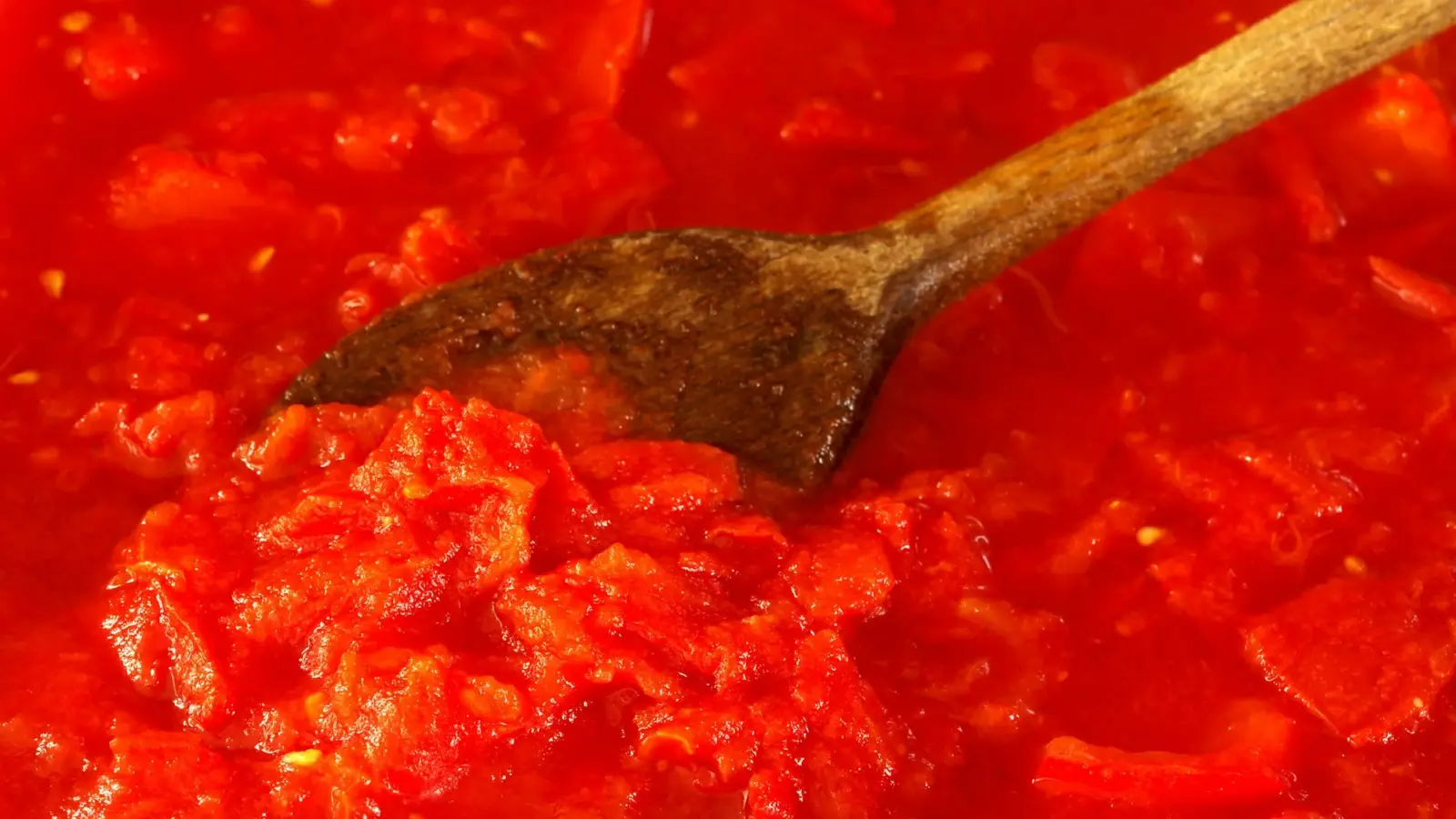
A good pizzeria-style sauce takes about 10 minutes of work and never sees the stove: canned tomatoes crushed by hand, a little salt, a pinch of dried oregano and a spoonful of olive oil. It goes onto the dough raw and cooks in the oven, which keeps it bright and tomatoey instead of stewed.
With so few ingredients, three details carry the recipe: the can you buy, how smooth you make it and how much goes on each pie.
Why pizzerias often skip cooking the sauce
A thin layer of sauce reduces and loses its raw edge in the time it takes the crust to brown. Cook it beforehand and it gets heated twice, once in the pot and again on the pie.
Jeff Zeak lays out the trade-off in a PMQ Pizza Magazine column on cooked versus uncooked sauce. Uncooked sauce keeps more fresh tomato flavor. A long simmer builds a deeper, darker sauce but drives off aromas, and that cooked taste can tip toward scorched on a lightly topped pie. His verdict: it comes down to preference, and plenty of successful pizzerias do simmer.
On a plain cheese slice, where sauce and mozzarella are nearly all you taste, uncooked earns its place. It does need a properly hot oven: if the center stays pale and wet, see our guide to baking crisp pizza in a home oven before blaming the sauce.
Choosing the canned tomatoes
Since nothing gets cooked, the sauce tastes almost exactly like the can, so the tomatoes are the one ingredient worth fussing over.
Tip: Open two or three brands and taste a piece of each straight from the can. Buy the one that tastes sweet, bright and clean rather than tinny, flat or salty, and check its label for salt so you know how much to add.
Whole peeled, crushed or purée
| Product | What’s in the can | Use it when |
|---|---|---|
| Whole peeled, domestic | Firm plum tomatoes in thin juice, often with calcium chloride | You want an affordable everyday sauce and full control of texture |
| Whole peeled, San Marzano DOP | Softer tomatoes, no calcium chloride, higher price | You prefer their flavor in a side-by-side taste |
| Crushed | Tomato pieces in purée; thickness varies widely by brand | You want zero prep and like the brand’s consistency |
| Purée or passata | Smooth and thick; usually cooked down further | You want a perfectly smooth layer |
Whole peeled tomatoes are the default: you choose the texture and can drain off the thin canning liquid that would water down the pie. Thicker products, Zeak notes, have generally been heated more to concentrate them.
Many domestic cans list calcium chloride, a firming salt; federal standards cap the calcium in canned whole tomatoes at 0.045 percent of their weight. In its 2023 tasting of whole canned tomatoes, America’s Test Kitchen noted that it helps tomatoes hold their shape, so they break down less. That’s harmless in a sauce, but firmed tomatoes resist hand-crushing; a food mill or a quick pulse helps.
What “San Marzano DOP” on a label means
San Marzano is a variety; San Marzano DOP is a legal designation. The official production rules reserve “Pomodoro San Marzano dell’Agro Sarnese-Nocerino” for peeled S. Marzano 2 or Kiros tomatoes grown and packed in listed towns in the provinces of Salerno, Avellino and Naples, picked by hand between July 15 and October 15, and sold only whole or in lengthwise fillets. Crushed or diced “San Marzano” is not DOP.
A genuine can shows the full name, the EU protected-designation symbol, “DOP,” the words “pomodori pelati interi” or “a filetti,” the producer, the harvest year and the round DOP logo, a cluster of red San Marzano tomatoes in front of a stylized Vesuvius. The consortium says each label carries a number it issues, and the can itself must be stamped “SM.” The only permitted additions are salt, basil leaves, a little citric acid and juice or purée made from DOP-grown tomatoes, so calcium chloride on the ingredient list rules a can out.
“San Marzano style” on a can means a different product, which may still taste fine. DOP cans cost more: upwards of $6 per 28-ounce can when America’s Test Kitchen priced them in 2023, against about $3.50 to $4.25 a can for domestic San Marzano-style tomatoes. That panel recommended every brand it tasted, imported and domestic. Buy DOP for the taste, not the label.
Controlling texture: hands, food mill or blender
Hand-crushed sauce keeps small bits of tomato; milled sauce spreads into a smooth, even layer. Neither is more correct.
| Method | Result | Watch for |
|---|---|---|
| Hands | Rustic, with pea-size pieces | Firm tomatoes leave bigger chunks; squeeze below the surface so they don’t squirt |
| Food mill, medium disk | Smooth and even; strains out seeds and stray peel | Slower, and one more thing to wash |
| Immersion blender | Fairly smooth in seconds | Long blending whips in air, paling the color and making it foamy |
| Blender or food processor | Smoothest and fastest | Easy to overdo; 2 to 4 one-second pulses is plenty |
Stir the olive oil in by hand at the end. When America’s Test Kitchen emulsified extra-virgin olive oil for aïoli in a food processor, tasters found it markedly bitter next to a hand-whisked batch; fast blades shatter the oil into droplets that release bitter compounds.
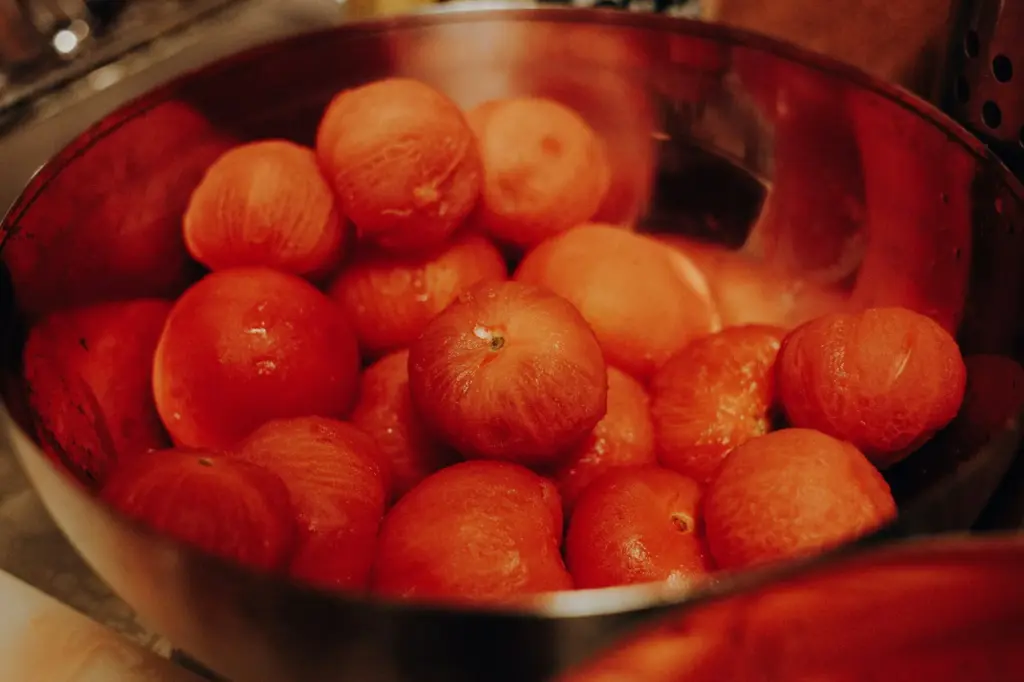
Aim for a sauce that coats a spoon thickly and spreads without running. If a spoonful on a plate leaks a ring of watery liquid, it will soak the middle of the pie; add back less of the reserved juice.
No-Cook New York-Style Pizza Sauce
An uncooked pizzeria-style sauce of hand-crushed canned tomatoes, salt, oregano and olive oil that takes 10 minutes of prep and cooks on the pie.
- Prep
- 10 min
- Rest so the oregano softens and the flavors even out
- 30 min
- Total
- 40 min
- Yield
- About 2¼ cups (530 ml), enough for three 14-inch (36 cm) pizzas
- Serves
- 6
- Oven
- Not needed for the sauce; it cooks on the pizza in a fully preheated oven
Ingredients
Sauce
Equipment
- Fine-mesh strainer or colander
- Large mixing bowl
- Food mill or immersion blender (optional)
- Measuring spoons
- Kitchen scale (optional, for portioning)
- Airtight glass or plastic container
Instructions
- Drain the tomatoes Set a strainer over a bowl and pour in the tomatoes. Let them drain for about 5 minutes, and keep the juice.
- Trim Pull out any hard stem cores, bits of peel or basil leaves. Firm, pale cores won't soften in the oven.
- Crush In a large bowl, squeeze the tomatoes through your fingers, hands below the surface so they don't squirt, until the largest pieces are pea-size. For a smoother sauce, use a food mill with the medium disk or 2 to 4 short pulses of an immersion blender.
- Adjust the thickness Stir in the reserved juice 1 tablespoon (15 ml) at a time until the sauce coats a spoon thickly and spreads without running. Most cans need only 2 to 4 tablespoons (30 to 60 ml); save the rest for soup or braising.
- Season Add half the salt, the oregano (rub it between your palms as it goes in) and the garlic, if using. Stir in the olive oil by hand.
- Taste and adjust Taste the sauce, ideally on a piece of bread. Add the remaining salt if it tastes flat, and add sugar a pinch at a time only if the tomatoes taste sharp or sour.
- Rest Cover and let stand for 30 minutes at room temperature, or refrigerate overnight. Don't leave it at room temperature for more than 2 hours.
- Sauce the pizza Spread 4 oz (115 g) on a 12-inch pizza, 5½ to 6 oz (155 to 170 g) on a 14-inch or 7 to 8 oz (200 to 225 g) on a 16-inch, leaving a 1-inch (2.5 cm) bare rim. Bake in an oven fully preheated to 500°F (260°C) or higher until the exposed sauce looks darker and thicker and the cheese bubbles and browns in spots.
- Store Refrigerate leftovers in a covered glass or plastic container for up to 5 days, or freeze in single-pizza portions for 2 to 3 months.
Notes
- Yield varies by brand, because drained weight differs from can to can.
- Crushed tomatoes: skip steps 1 to 4 and season one 28-ounce (794 g) can as in steps 5 to 7. It makes roughly 3¼ cups (770 ml), enough for four to five 14-inch pizzas.
- For a simmered sauce, see the cooked variation in the article; it keeps 3 to 4 days in the refrigerator.
How much sauce for a 12-, 14- or 16-inch pizza
Sauce scales with the area of the pie, not its width: a 16-inch pizza has about 1.8 times the surface of a 12-inch. In a PMQ piece on saucing technique, Dan Risner gives 4 ounces for a 12-inch pizza and 6 ounces for a 14-inch, and scaling by area puts a 16-inch near 8. King Arthur Baking’s New York-style recipe uses about ½ cup (130 g) on a 13-inch pie. Both land near 1 gram of sauce per square inch.
| Pizza | Surface area | Sauce by weight | Approximate volume |
|---|---|---|---|
| 12-inch (30 cm) | 113 sq in | 4 oz (115 g) | ½ cup (120 ml) |
| 14-inch (36 cm) | 154 sq in | 5½–6 oz (155–170 g) | ⅔–¾ cup (160–180 ml) |
| 16-inch (41 cm) | 201 sq in | 7–8 oz (200–225 g) | Scant 1 cup (210–235 ml) |
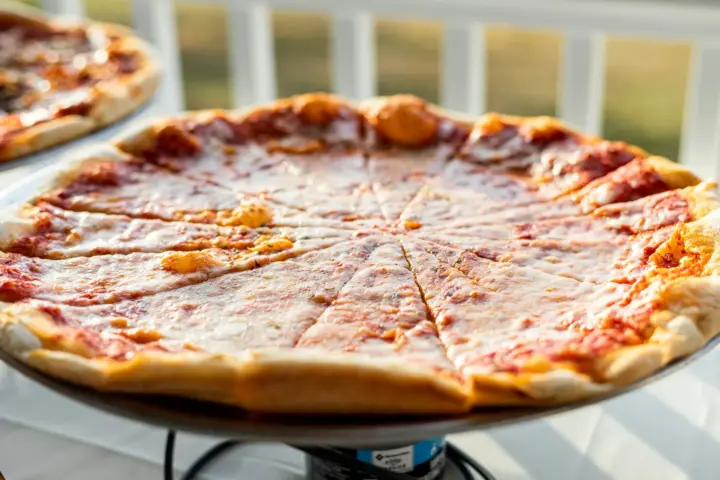
Spoon the sauce into the center and spread it in a spiral with the back of the spoon, leaving a bare rim about 1 inch (2.5 cm) wide, since sauce spreads as it heats. Assembly and baking are in our classic New York cheese pizza recipe, which starts from our New York-style pizza dough.
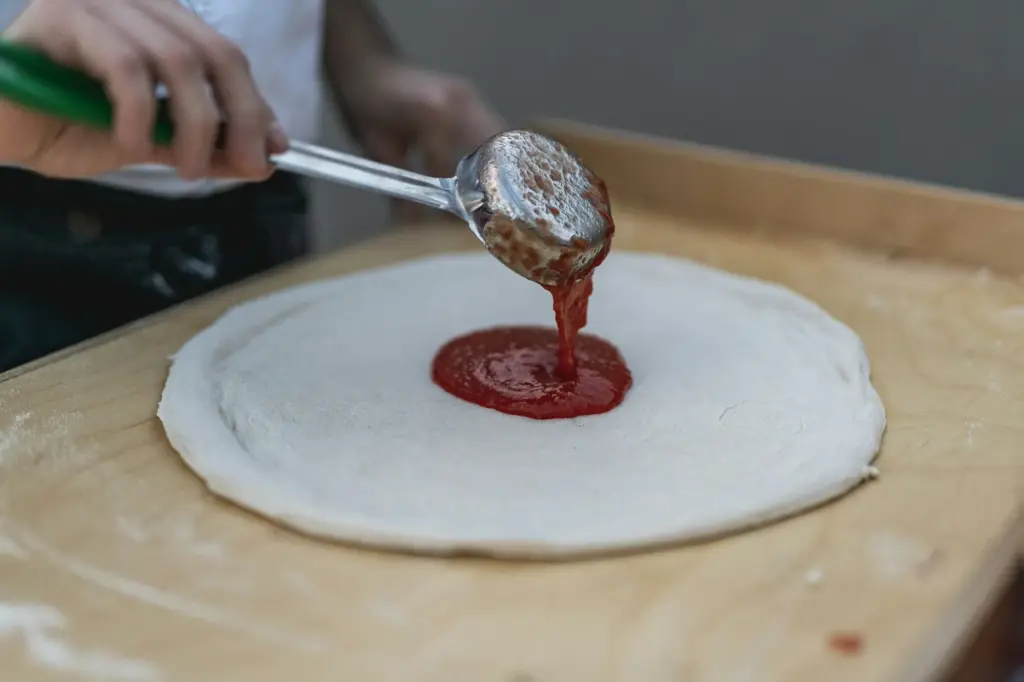
On the baked pie, sauce showing between the cheese should look darker and thicker than it went on, with no watery shine. A soggy center under a browned rim usually means too much sauce or a baking surface that wasn’t fully preheated.
Common pizza sauce mistakes
- Too much sauce. Extra sauce is extra water, and it pools where the crust is thinnest. Weigh it the first few times.
- Skipping the drain. The thin liquid in a can of whole tomatoes is what makes sauce runny. Drain it and add back only what you need.
- Seasoning by the recipe, not by taste. Cans range from unsalted to well salted. Add half the salt, taste, then decide. Sugar is a fix for sour tomatoes, not a standard ingredient.
- Ignoring the cheese. Fresh mozzarella carries more water than low-moisture, so go lighter on sauce with it. Our guide to choosing mozzarella and other pizza cheeses explains why.
Cooked pizza sauce variation
For a sweeter, more concentrated sauce, simmer it. Warm 2 tablespoons (30 ml) olive oil in a 3-quart (2.8-liter) saucepan over medium-low heat. Add 2 finely grated garlic cloves and cook 30 to 60 seconds, until fragrant but not browned.
Add one 28-ounce (794 g) can of whole peeled tomatoes, hand-crushed with all their juice (no need to drain; the simmer reduces it), ½ teaspoon dried oregano and half the salt from the recipe card. Simmer gently, uncovered, with small bubbles breaking at the surface, stirring every few minutes, for 25 to 35 minutes. It’s ready when reduced by about a third and a spoon drawn across the pan bottom leaves a trail that fills in slowly. Season to taste. It makes about 2¼ cups (530 ml).
Cool it completely before using, since warm sauce softens stretched dough, and portion it as above. For pasta, our homemade marinara for pasta and pizza is the better recipe.
Storing, freezing and making ahead
The USDA’s Shelf-Stable Food Safety fact sheet gives opened high-acid canned goods, tomatoes included, 5 to 7 days in the refrigerator, and suggests moving leftovers from the can into glass or plastic for best flavor. Because the uncooked sauce also holds fresh garlic, plan on 5 days, the short end of that range and the same window King Arthur gives its uncooked sauce.
Treat the cooked version like leftovers: 3 to 4 days, the time the FoodSafety.gov cold storage chart (reproduced by University of Delaware Cooperative Extension) gives soups and stews. Keep the refrigerator at 40°F (4°C) or below, and follow the CDC’s rule of refrigerating within 2 hours, or 1 hour above 90°F (32°C).
Both versions freeze well. The chart has no tomato-sauce row; its closest match, soups and stews, gives 2 to 3 months at 0°F (−18°C) for best quality. Freeze single-pizza portions in flat zip-top bags, thaw overnight in the refrigerator and stir before using.
Note: Making the sauce a day ahead is the easiest upgrade: the oregano softens and the flavors even out overnight. No need to warm it; cold sauce spreads fine after 15 minutes on the counter.
Sources
- To Cook or Not to Cook, PMQ Pizza Magazine (Jeff Zeak)
- Saucing a Pizza, PMQ Pizza Magazine (Dan Risner)
- Disciplinare di produzione della DOP "Pomodoro San Marzano dell'Agro Sarnese-Nocerino", Italian Ministry of Agricultural, Food and Forestry Policies, via Consorzio di Tutela del Pomodoro San Marzano DOP
- Consorzio del Pomodoro San Marzano DOP (home page: label numbering), Consorzio di Tutela del Pomodoro San Marzano dell'Agro Sarnese-Nocerino DOP
- The Best Whole Canned Tomatoes (taste test, September 2023), America's Test Kitchen
- Testing Olive Oil's Bitter End, America's Test Kitchen
- 21 CFR 155.190 - Canned tomatoes (calcium salts as firming agents), Legal Information Institute, Cornell Law School
- New York-Style Pizza (recipe from The Book of Pizza), King Arthur Baking
- Ingredient Weight Chart, King Arthur Baking
- Shelf-Stable Food Safety (fact sheet, updated August 2014), USDA Food Safety and Inspection Service, via GovInfo
- Keep Food Safe: Guide to Refrigerator Storage Periods (August 2025; reproduces the FoodSafety.gov Cold Food Storage Chart), University of Delaware Cooperative Extension
- Four Steps to Food Safety, Centers for Disease Control and Prevention