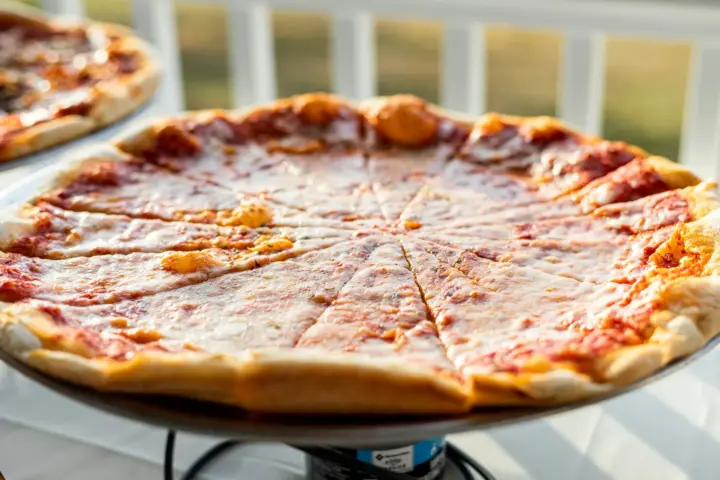
New York-Style Pizza Dough: A Step-by-Step Recipe
Bread flour, 62% hydration and one to three days in the fridge make two thin, foldable 14-inch pies with a crisp base and a chewy rim.
This is the dough the rest of our pizza recipes are built on: bread flour, 62% water, a little olive oil and sugar, a pinch of instant yeast, and at least a full day in the refrigerator. It makes two 380 g balls, each enough for a thin, foldable 14-inch (36 cm) New York-style pie with a crisp underside and a chewy rim.
The hands-on work takes about 30 minutes; the fridge does the rest. Mix it one to three days before pizza night, or use the same-day fallback below the recipe.
The formula in baker’s percentages
Professional bakers and pizza makers write dough formulas in baker’s percentages: each ingredient is a share of the flour weight, which is always 100%. That makes a formula easy to read and easy to scale.
| Ingredient | Weight | Baker’s % | What it does |
|---|---|---|---|
| Bread flour | 450 g | 100% | Structure and chew |
| Water | 279 g | 62% | A dough soft enough to stretch thin |
| Salt | 11 g | 2.4% | Flavor; tightens gluten and slows the yeast |
| Olive oil | 9 g | 2% | Tenderness, easier stretching, browning |
| Sugar | 9 g | 2% | Browning in a home oven |
| Instant yeast | 2 g | 0.44% | A slow, steady rise in the cold |
| Total | 760 g | 168.9% | Two 380 g balls |
For other sizes, keep the dough per square inch the same, about 2.5 g: roughly 280 g for a 12-inch pie, 495 g for 16 inches and 630 g for 18. Divide the total dough weight you need by 1.689 to get the flour, then multiply the flour by each percentage.
Why a cold ferment makes a better crust
Yeast makes gas quickly and flavor slowly. At room temperature the gas wins, and the dough is ready before much flavor has developed. In a refrigerator at or below 40°F (4°C), the setting the FDA recommends for home fridges, fermentation slows to a crawl while the flavor work carries on.
Over 24 to 72 hours, the yeast produces acids and aromatic compounds, the flour’s own enzymes break some starch down into sugars, and the gluten keeps strengthening with no extra kneading. You get a crust that tastes like bread rather than raw flour, a dough that stretches instead of fighting back and a rim that browns more readily. Three days is the ceiling, the same limit King Arthur gives for refrigerating its New York-style dough; past that, this dough turns slack and sour.
Why there is oil and sugar in the dough
Home ovens top out around 500 to 550°F (260 to 290°C), where a lean dough of flour, water, salt and yeast can dry out before it browns. Two percent sugar gives the crust a head start on color, and two percent olive oil keeps the crumb tender and the dough stretchy. The oven setup matters just as much; our guide to baking crispy pizza in a home oven covers it.
Ingredient notes and substitutions
Flour
Bread flour is the practical choice. King Arthur’s, for example, is 12.7% protein, enough gluten for a thin crust that folds without cracking. High-gluten flour (about 14% protein, sold for New York-style pizza and bagels) gives a chewier, more pizzeria-style bite at the same 62% water. All-purpose flour makes a softer, more tear-prone dough, so drop the water to about 60% (270 g). Our comparison of bread flour vs. 00 flour covers the Italian alternative.
Weigh the flour if you can. A cup of bread flour weighs anywhere from 120 g, the figure on King Arthur’s ingredient weight chart, to about 130 g depending on how it is filled, enough to shift the hydration by several points.
Salt and yeast
The 11 g of salt equals about 1¾ teaspoons of table salt, 2 teaspoons of Morton kosher or 4 teaspoons of Diamond Crystal kosher; King Arthur lists Diamond Crystal at half Morton’s weight per tablespoon, 8 g against 16 g. Active dry yeast can replace instant at the same weight. King Arthur notes it no longer needs to be dissolved first, though it starts a little more slowly.
Tip: At 2 g, the yeast is hard to weigh on a scale that reads in 1 g steps. Measure ½ teaspoon plus ⅛ teaspoon instead. Too much yeast is the easiest route to flat, boozy-smelling dough by day two.
Water
Aim for a finished dough of 75 to 78°F (24 to 26°C), the range King Arthur cites for wheat-based yeast doughs. That usually means water around 75°F (24°C) for hand kneading, or closer to 65°F (18°C) for a stand mixer, which warms the dough as it works.
Kneading by hand or with a stand mixer
Stir everything together until no dry flour remains, then cover and rest 15 minutes. The flour hydrates, and kneading goes faster.
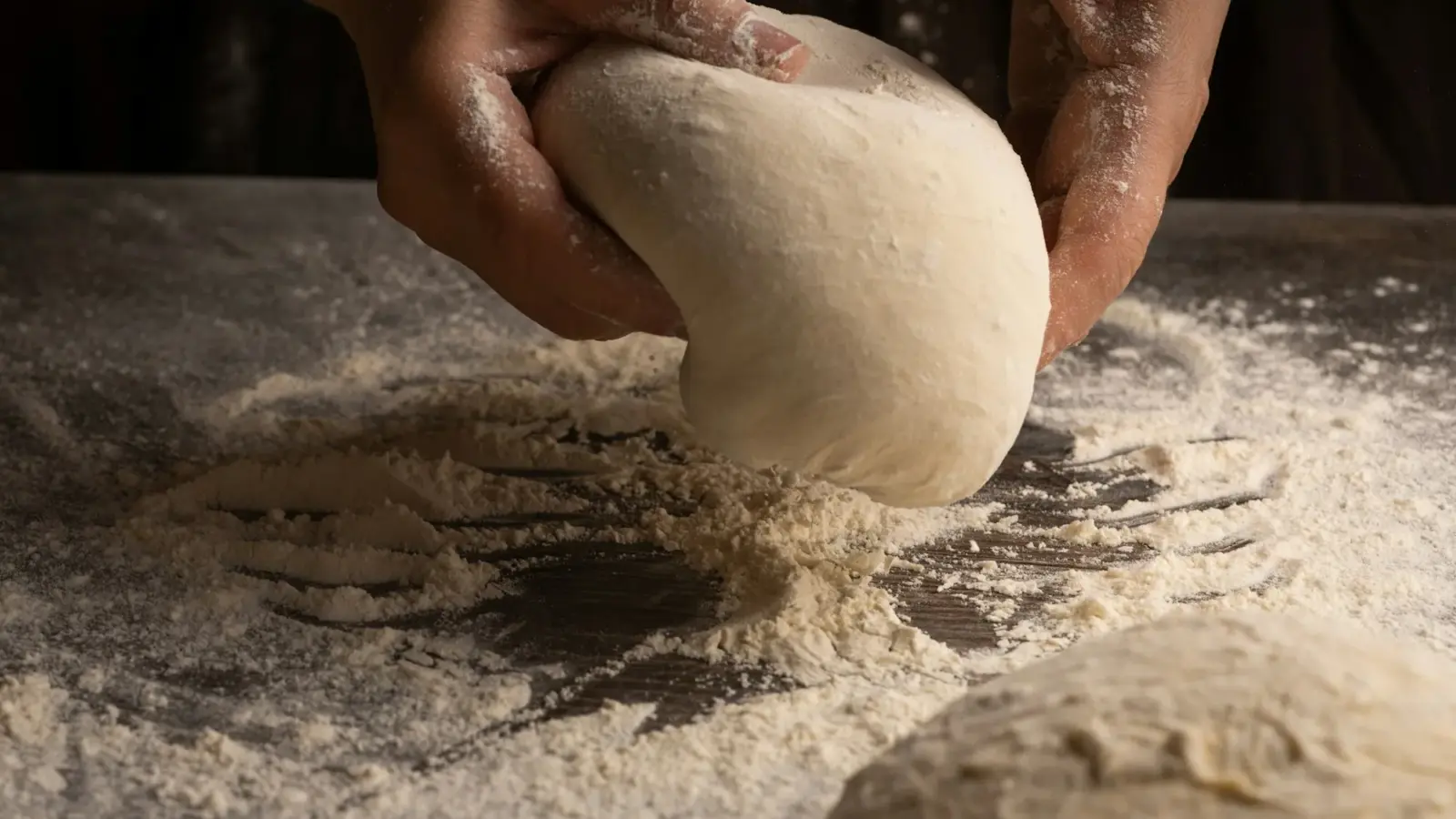
By hand: Knead on an unfloured counter with a push, fold and turn rhythm for 10 to 12 minutes. The dough starts shaggy and tacky; resist adding flour, which throws off the hydration. Damp hands help more.
Stand mixer: Use the dough hook on speed 2, the speed KitchenAid recommends for kneading with the hook, for 7 to 8 minutes, until the dough clears the sides of the bowl and looks smooth.
The windowpane test, adjusted for a cold ferment
Pinch off a ping-pong-ball-size piece, flatten it and pull it gently from opposite sides. Fully developed dough stretches thin enough to let light through before tearing, but this dough does not need to get there. As King Arthur’s explainer on the windowpane test notes, dough that will rise for hours, in the bowl or in the fridge, can go into that rest much less developed, because its gluten keeps strengthening as it sits.
Stop when the dough is smooth and springy and the test piece turns partly translucent before it tears. Kneading to a perfect pane now can leave you with a tight dough that resists stretching later.
Balling and the cold ferment
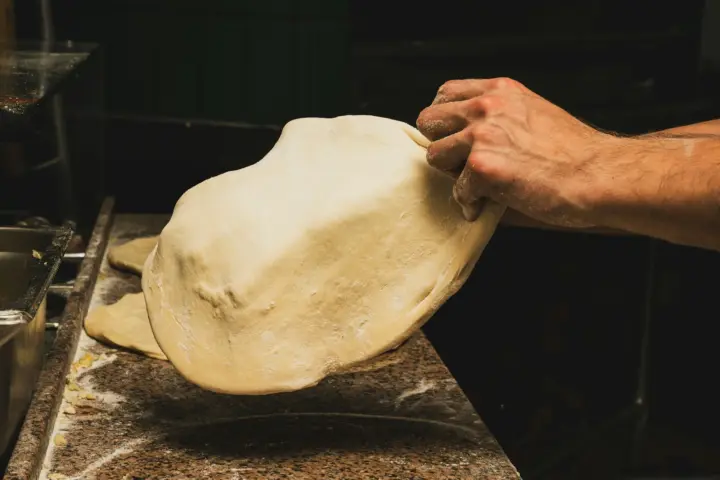
Divide the dough into two 380 g pieces. Fold the edges of each into the center, turn it seam-side down and drag it toward you with cupped hands until the surface is smooth and taut. A tight ball opens into an even circle; a loose one stretches unevenly.
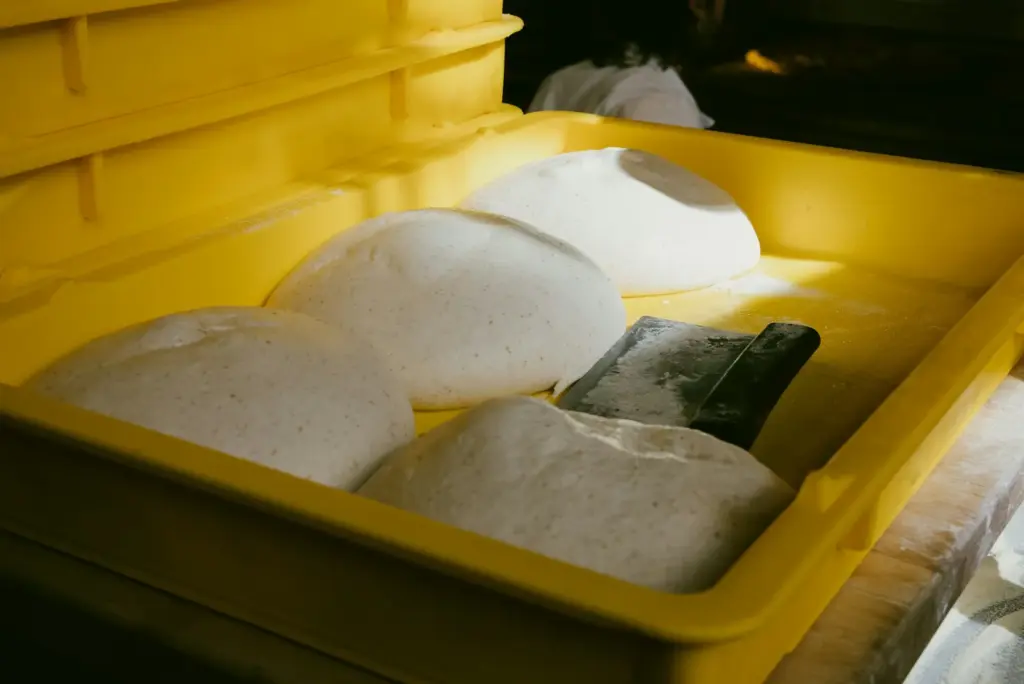
Put each ball in a lightly oiled, lidded 1-quart (1 L) container and seal it well, since exposed dough grows a dry skin that cracks when stretched. Refrigerate for 24 to 72 hours. By day two the balls will have spread and puffed, with small bubbles visible through the container.
Bringing the dough to room temperature
Cold dough is stiff and snaps back. Set the covered containers on the counter 2 to 3 hours before baking; the dough is ready when it is soft and relaxed and a floured fingertip dent fills back in slowly. Preheat the oven and steel during this window.
Flour the ball and the counter well, tip the dough out and stretch it to 14 inches. Our guide to stretching pizza dough without tearing it covers the knuckle stretch and patching holes. Spread on a no-cook homemade pizza sauce, then follow our classic New York cheese pizza recipe for the cheese, the amounts and the bake.
New York-Style Pizza Dough
A cold-fermented bread-flour dough at 62% hydration that makes two 380 g balls for thin, foldable 14-inch New York-style pizzas.
- Prep
- 30 min
- Cook
- 20 min
- 15-minute rest, 24-hour cold ferment (up to 72 hours) and 2-hour warm-up
- 1 day 2 hr
- Total
- 1 day 3 hr
- Yield
- Two 14-inch (36 cm) pizzas; two 380 g dough balls
- Serves
- 4
- Oven
- 500–550°F (260–290°C), pizza steel or stone preheated 1 hour
Ingredients
Dough
For the containers and shaping
Equipment
- Digital kitchen scale
- Large mixing bowl or stand mixer with dough hook
- Bench scraper
- Two 1-quart (1 L) lidded containers
- Pizza steel or baking stone
- Pizza peel
- Instant-read thermometer (optional)
Instructions
- Combine the dry ingredients In a large bowl or the bowl of a stand mixer, whisk the flour, sugar, salt and instant yeast until evenly mixed.
- Add the water and oil Add the water and the 2 teaspoons (9 g) of olive oil and stir, by spoon or with the dough hook on low, until no dry flour remains. Cover and rest 15 minutes.
- Knead the dough Knead by hand on an unfloured counter for 10 to 12 minutes, or with the dough hook on speed 2 for 7 to 8 minutes, until smooth, springy and only slightly tacky. The dough should be about 75 to 78°F (24 to 26°C).
- Check with a windowpane test Stretch a small piece between your fingers: it should turn partly translucent before tearing. A perfect windowpane is not needed; the cold ferment keeps building gluten.
- Divide and ball Divide the dough into two 380 g pieces and shape each into a smooth, taut ball, seam-side down.
- Cold ferment Place each ball seam-side down in a lightly oiled 1-quart (1 L) container, cover tightly and refrigerate at or below 40°F (4°C) for 24 to 72 hours.
- Warm the dough Two to 3 hours before baking, set the covered containers on the counter until the dough is soft and relaxed and a floured fingertip dent fills back in slowly.
- Preheat the oven While the dough warms, and at least 1 hour before baking, set a pizza steel or stone in the oven and heat it to the highest setting, 500 to 550°F (260 to 290°C).
- Stretch the dough Flour one ball and the counter well, turn the dough out and stretch it into a 14-inch (36 cm) round with a ½- to ¾-inch (1 to 2 cm) rim. Move it to a peel dusted with semolina.
- Top and bake Top lightly with sauce and cheese and slide the pizza onto the steel or stone. Bake 6 to 10 minutes, until the rim is deep golden brown with darker spots, the underside is browned and crisp and the cheese is bubbling. Let the steel reheat a few minutes, then bake the second pizza.
Notes
- Same-day dough: use 1½ teaspoons (4.5 g) instant yeast and 85°F (29°C) water; let it rise until roughly doubled, 1½ to 2 hours, then ball and rest 30 to 60 minutes.
- To freeze: after 24 hours in the fridge, freeze the balls individually wrapped for up to 2 weeks. Thaw covered in the refrigerator for 12 to 24 hours, then rest 2 to 3 hours at room temperature.
- Do not taste raw dough; raw flour is only safe once baked.
Same-day New York-style dough
For pizza in about 3 hours, raise the instant yeast to 1½ teaspoons (4.5 g, 1%) and use water at about 85°F (29°C). Let the kneaded dough rise, covered, until roughly doubled, 1½ to 2 hours, then ball it and rest the balls 30 to 60 minutes before stretching. Expect a flatter-tasting, slightly paler crust.
For dough mixed in the morning and baked at dinner, cut the yeast to ¼ teaspoon and use cool water, 60 to 70°F (16 to 21°C). Rest the dough an hour, ball it and leave the covered balls on the counter for 8 to 10 hours, the room-temperature schedule King Arthur uses for its New York-style pizza. This formula has a little less yeast per gram of flour than King Arthur’s, so lean toward the full 10 hours; the balls are ready when they have puffed and spread. The slow rise builds more flavor than the 3-hour version.
Common New York-style dough mistakes
- The dough snaps back as you stretch. It is still cold or under-rested. Cover it and give it another 30 minutes.
- It tears or goes paper-thin in spots. Usually under-kneading, a loosely shaped ball or overfermented dough. Pinch small holes closed and stretch more gently around them.
- The balls are flat, gassy and sour-smelling. Too much yeast, a fridge running warmer than 40°F (4°C) or more than 72 hours. Bake it anyway; it will be flatter and paler.
Make-ahead, freezing and safety
Bake the dough within 72 hours of mixing. To keep it longer, give the balls their first 24 hours in the fridge, freeze them on a plate until firm, then wrap each one tightly and bag it. America’s Test Kitchen’s method calls for using frozen balls within about 2 weeks and thawing them, covered, in the refrigerator for 12 to 24 hours; after that, give them the usual 2 to 3 hours on the counter. Our guide to freezing pizza dough has the details.
Food safety: The FDA’s guidance on handling flour safely is direct: “Never eat or taste raw flour, dough, or batter.” Flour can carry bacteria such as E. coli and Salmonella, and only cooking makes it safe. Wash your hands, counters and tools after handling dough.
Sources
- Ingredient Weight Chart, King Arthur Baking
- What is the windowpane test for bread dough?, King Arthur Baking (PJ Hamel, Oct. 14, 2022)
- New York-Style Pizza, King Arthur Baking
- Pizza Crust, King Arthur Baking
- Desired dough temperature, King Arthur Baking (Barb Alpern, May 29, 2018)
- Active dry versus instant yeast, King Arthur Baking (PJ Hamel, Aug. 15, 2022)
- Sir Lancelot High-Gluten Flour, King Arthur Baking Professional
- King Arthur Unbleached Bread Flour, King Arthur Baking
- Which Speed should I use on my Stand Mixer?, KitchenAid Product Help
- Bread Baking 101: How to Knead Dough, America's Test Kitchen
- Freezing Thin-Crust Pizza Dough, America's Test Kitchen
- Are You Storing Food Safely?, U.S. Food and Drug Administration
- Handling Flour Safely: What You Need to Know, U.S. Food and Drug Administration