Best Cheese for Pizza: Mozzarella and More
Moisture, fat, age and acidity decide how a cheese melts, stretches and browns. Here is how to choose it, shred it, portion it and layer it.
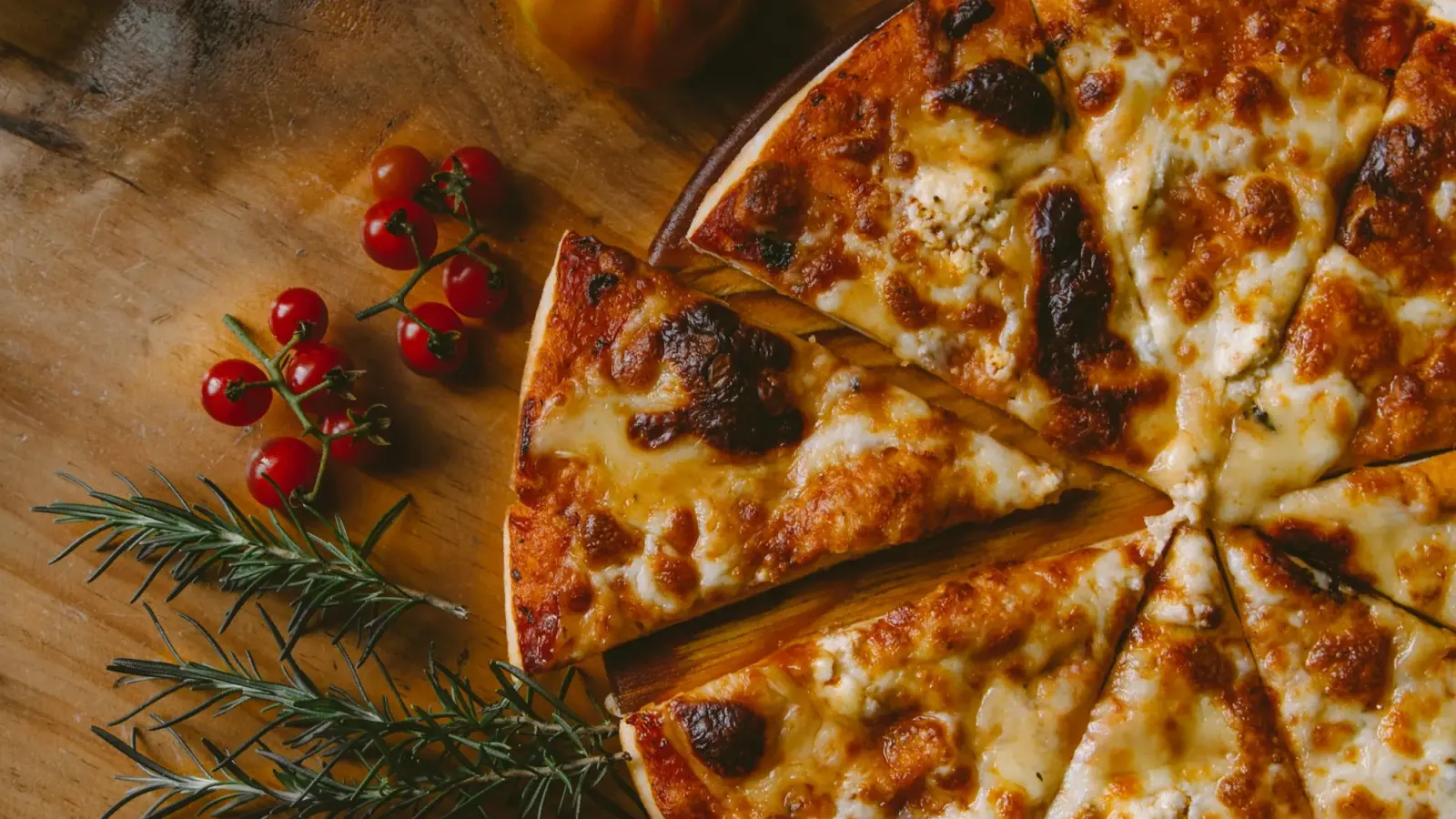
For most pizzas, the best cheese is low-moisture, whole-milk mozzarella shredded from a block. It melts into an even, stretchy sheet, gives off just enough fat to look glossy and browns in spots in the time a home oven needs to crisp the crust. Fresh mozzarella earns its place on fast, very hot bakes like Neapolitan pies, and a modest share of provolone, Parmigiano Reggiano or Pecorino Romano supplies the flavor mozzarella lacks.
At a glance
- Best all-purpose pick: low-moisture, whole-milk mozzarella, shredded from a block into chunky shreds.
- For fast, very hot ovens: fresh mozzarella (fior di latte) or buffalo mozzarella, torn and drained.
- For more flavor: blend in provolone, or add a light dusting of Parmigiano Reggiano or Pecorino Romano; keep mozzarella the majority.
- How much: a common pizzeria rule of thumb is 7 oz (200 g) on a 14-inch (35 cm) pie; 5 to 7 oz (140 to 200 g) is plenty in a home oven.
- Freezing: shredded mozzarella keeps its quality for 3 to 4 months frozen; thaw it in the refrigerator for 24 to 48 hours.
Why low-moisture mozzarella is the default
Mozzarella is a pasta filata, or stretched-curd, cheese: the curd is worked in hot water until it turns smooth and elastic, and that elasticity gives a slice its pull. Low-moisture mozzarella is the same cheese made drier. Under the US standard of identity, low-moisture mozzarella holds more than 45% but no more than 52% water, while regular mozzarella runs from 52 to 60%. Both need at least 45% milkfat in their solids; the part-skim versions drop that to 30 to 45%.
In a home oven, that gap matters. Over a bake of several minutes, a wetter cheese pools on the sauce before its water can evaporate, while low-moisture mozzarella melts into a continuous layer, sweats a little fat and browns in spots. Its mild flavor helps too: in 2001 a Leprino Foods executive told PMQ Pizza Magazine that mozzarella’s blandness suits pizza because it carries the other flavors.
Choose whole milk over part-skim when you can. Cheese consultant Mark Todd has told PMQ that whole-milk mozzarella melts and flows beautifully but resists browning, while part-skim, with more protein and less fat, browns faster and gets tough and rubbery as it cools. Whole-milk, low-moisture mozzarella is the cheese for a classic New York cheese pizza.
What makes a cheese melt, stretch, release oil and brown
Cheese is a network of casein proteins holding water and fat. As it heats, the fat melts and seeps to the surface, then the protein network loosens and flows. Scientific American, drawing on food scientists at Utah State University and the University of Wisconsin, puts full melting at around 160°F (71°C). Four things decide how that goes on a pizza.
Moisture
Water keeps the protein network loose, so moister cheeses melt sooner and flow farther, until the excess simply leaks out. Fresh mozzarella, at 52 to 60% water, needs draining or a very short bake. US parmesan, at no more than 32%, barely flows at all.
Fat
Fat keeps melted protein tender and is where the oil on a slice comes from. A heavy film of oil can hold moisture in and slow browning. The Leprino executive said chains usually blend mozzarellas to limit oil release or to get a particular flavor.
Age
Aging cuts casein into shorter pieces, so a cheese melts more easily but stretches less and turns soupy sooner. Young mozzarella and mild provolone stretch. Long-aged, dry Parmigiano and Pecorino soften and toast instead.
Acidity
Calcium phosphate bridges tie the casein together. John Lucey of the Wisconsin Center for Dairy Research explains in the same piece that some acid dissolves those bridges so cheese can flow, while too much makes the proteins cling together so it no longer stretches. A 2021 review in Food Technology and Biotechnology puts the best stretching point for mozzarella curd at pH 5.2 to 5.3. Ricotta, made mostly from whey proteins that set for good when heated, softens instead of melting.
Browning and blistering
Browning comes largely from the Maillard reaction between protein and leftover sugar, chiefly galactose left by the starter cultures. In a 1994 University of Nebraska study, two low-moisture part-skim mozzarellas that differed only in galactose content browned to significantly different degrees. On pizza, a consumer panel could tell them apart by color and found both acceptable. Leaner part-skim also browns sooner than whole-milk.
Blisters need elasticity. A 2014 University of Auckland study, covered by NPR, found that mozzarella’s stretch lets steam inflate bubbles; the oil slides off their tops and the exposed cheese browns. Cheddar barely bubbled but browned evenly, while oilier Gruyère bubbled but hardly browned because its fat held the moisture in.
Pizza cheeses compared
Water and fat figures are the limits in the US standards of identity, with fat measured as a share of the cheese’s solids. Imported PDO cheeses such as Parmigiano Reggiano are made to their own production rules.
| Cheese | Water / fat in solids | Melt and stretch | Oil and browning | Best use |
|---|---|---|---|---|
| Low-moisture whole-milk mozzarella | 45–52% / 45%+ | Smooth, even melt; long stretch | Moderate oil; browns in spots | New York-style and most home pizzas |
| Low-moisture part-skim mozzarella | 45–52% / 30–45% | Firmer melt; rubbery once cool | Little oil; browns fast | Blends, or a top layer for color |
| Fresh mozzarella (fior di latte) | 52–60% / 45%+ | Soft, milky pools | Releases water; browns lightly | Neapolitan and margherita pies |
| Buffalo mozzarella | Very moist, sold in brine; buffalo milk averages twice the fat of cow’s milk | Very soft and creamy | Wet; browns little | Finishing a margherita |
| Provolone | Up to 45% / 45%+ | Melts much like whole-milk mozzarella | Moderate oil; more flavor with age | Blending with mozzarella |
| Parmigiano Reggiano / parmesan | Up to 32% / 32%+ | Softens and toasts; no stretch | Little oil; scorches if piled on | A light layer, more after baking |
| Pecorino Romano / romano | Up to 34% / 38%+ | Softens; no stretch | Little oil; sharp flavor | Small amounts, especially on white pies |
| Ricotta | Fresh whey cheese, very moist | Softens; does not melt | Little oil; colors lightly on top | Spoonfuls on white pizza |
| Wisconsin brick | Up to 44% / 50%+ | Rich, smooth melt | High fat; caramelizes against a hot pan | Detroit-style pan pizza |
| Cheddar | Up to 39% / 50%+ | Melts readily; few blisters | Oily when aged; browns evenly | A minority share in blends |
How to use each cheese
Low-moisture mozzarella needs only shredding. The rest each have a catch.
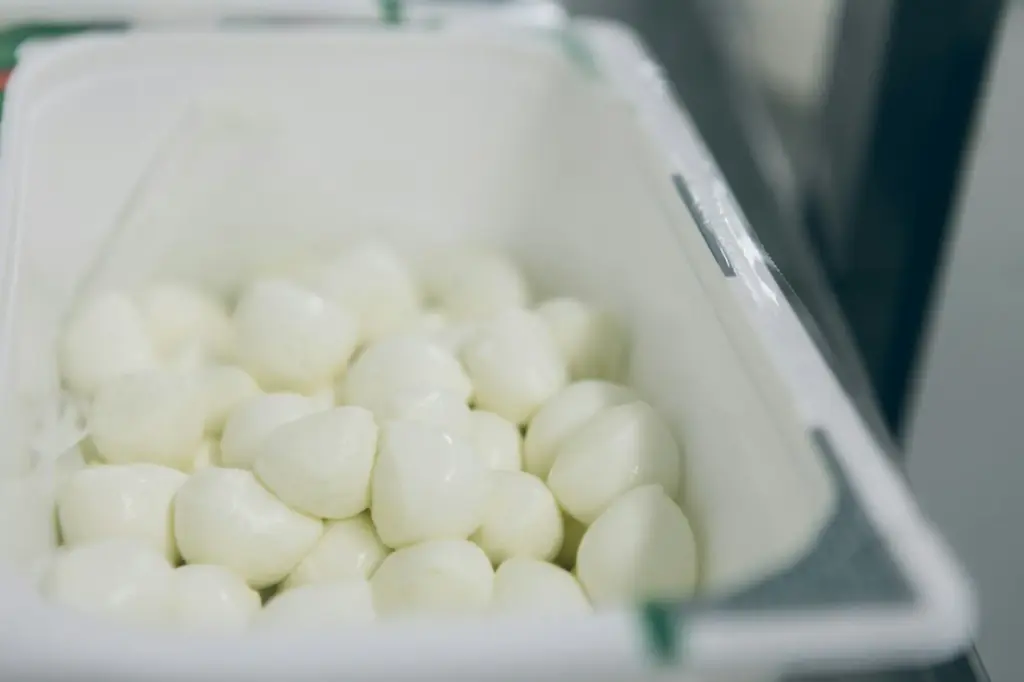
Fresh mozzarella and fior di latte
Fresh cow’s-milk mozzarella, called fior di latte in Italy, melts into soft, milky pools rather than a continuous sheet. It suits pies that bake in a minute or two in a very hot oven, the style explained in how New York and Neapolitan pizza differ, and it is the classic cheese on a margherita pizza. In a home oven its water has time to escape, so slice or tear it, drain it on paper towels and keep it cold until it goes on. Todd’s advice to pizzerias is to let it drain overnight.
Warning: A pool of whey around fresh mozzarella means a soggy center. Use less of it than you would shredded cheese, leave gaps between the pieces and, on a long home-oven bake, add it halfway through.
Buffalo mozzarella
Mozzarella di Bufala Campana DOP is made only from water-buffalo milk, which the UN Food and Agriculture Organization says averages twice the fat of cow’s milk. It is sold in its own liquid, sweats whey when cut, and its producers’ consortium recommends eating it the day you buy it. Treat it as a finishing cheese: tear it over the pie for the last minute of baking or straight out of the oven.
Provolone
Provolone is a stretched-curd cheese like mozzarella, drier and cured longer, so it carries more flavor. Todd has told PMQ that a two-year-old provolone melts much like whole-milk mozzarella but adds big flavor, and a consultant quoted there in 2013 called mozzarella, provolone and Parmesan the most common pizzeria blend. Todd’s Italian-leaning blend is 10% mild provolone, 10% aged provolone and 80% part-skim mozzarella.
Parmigiano Reggiano and Pecorino Romano
These season rather than melt. Parmigiano Reggiano is made from raw cow’s milk, rennet and salt and aged at least 12 months, according to a World Intellectual Property Organization profile. Pecorino Romano is a sheep’s-milk cheese from Sardinia, Lazio and the province of Grosseto, aged at least 8 months for grating. Both are dry enough to scorch, so go light: King Arthur’s New York-style recipe uses about 2 tablespoons (6 g) of grated Parmigiano per pie, plus more after baking. Use a little less of the sharper Pecorino.
Note: In the US, a cheese labeled simply “Romano” may be made from cow’s, sheep’s or goat’s milk. For the sharp, sheepy flavor, look for “Pecorino Romano.”
Ricotta
Ricotta holds its shape and stays creamy instead of melting, so it goes on in spoonfuls between patches of mozzarella. Choose whole-milk ricotta and drain it in a sieve if it looks wet. Our white pizza with ricotta and garlic is built around it.
Wisconsin brick
Brick is a semi-soft, washed-rind cheese first made in Wisconsin in 1877 by Swiss-born cheesemaker John Jossi, according to culture magazine. Its flavor starts modest and turns fuller and more savory with age. Its butterfat, at least 50% of solids under the US standard, is the point on Detroit-style pizza. Buddy’s, which opened in Detroit in 1946, calls for Wisconsin brick “crumbled, not shredded, and spread edge-to-edge,” so it forms a crisp, caramelized crust against the pan. Without brick, try whole-milk mozzarella with some Monterey Jack.
Cheddar
Cheddar melts readily but blisters very little and stretches less than mozzarella. An aged one, its casein already broken down, is quicker to turn soupy. Keep a young, mild cheddar to a small share of a blend; one Todd blend uses just 10%.
Pre-shredded vs. shredding your own
Bagged shredded mozzarella is coated with anti-caking agents, usually powdered cellulose, potato starch or cornstarch, to keep the shreds from fusing. The coating gets more blame than the research supports. A 2002 Virginia Tech study found no significant difference in meltability or stretch between uncoated shreds and shreds coated with cellulose or potato starch, and a 2024 University of Wisconsin–Madison thesis found the coatings increased the number and color of blisters on baked pizza.
America’s Test Kitchen’s shredded mozzarella tasting agreed: the coatings made raw shreds gritty, but on pizza texture mattered much less, and lab tests pointed to fat, not starch or cellulose, as the reason some brands melted dense and rubbery. Shred size counted too. The favorites were about 2.8 mm thick, against as little as 0.9 mm for lower-ranked brands, and melted in evenly browned sheets.
So the case for shredding your own is fat and freshness. Six of the seven brands in that tasting were part-skim, and the one whole-milk shred was later discontinued. A whole-milk block shredded on the large holes of a box grater gives you the richer melt and chunky shreds that brown evenly.
Tip: Shred cheese straight from the refrigerator; warm mozzarella smears on the grater. Use the shreds within a few days.
How much cheese for a 14-inch pizza
Pizzerias portion cheese by weight, scaled to the pie’s area. Todd’s rule of thumb, as reported by PMQ in 2024, is “5-7-9-11,” which works out to about 0.045 oz per square inch:
- 12-inch (30 cm) pie: 5 oz (140 g)
- 14-inch (35 cm) pie: 7 oz (200 g)
- 16-inch (40 cm) pie: 9 oz (255 g)
- 18-inch (45 cm) pie: 11 oz (310 g)
For home ovens, treat those numbers as the ceiling. King Arthur’s New York-style recipe uses 7 oz (198 g) of low-moisture mozzarella across two 13-inch pies, plus grated Parmigiano, and a thinner layer melts and browns sooner in an oven that tops out at 500 or 550°F (260 or 290°C). For a 14-inch home pie, 5 to 7 oz (140 to 200 g) of shredded low-moisture mozzarella, about 1¼ to 1¾ cups, is the sensible range. With fresh mozzarella, start at the low end.
If the cheese browns before the crust crisps, the fix is usually the oven setup rather than the cheese; see our guide to baking crispy pizza in a home oven for rack position and broiler timing.
The right layering order
For New York-style and most other round pies, build from the bottom up:
- Sauce: a thin layer of homemade pizza sauce, leaving a bare rim.
- Grated hard cheese, if using, over the sauce or mixed with the mozzarella.
- Mozzarella and any provolone, spread evenly to about ½ inch (1.3 cm) from the rim. If you blend whole-milk and part-skim, Todd’s advice is whole-milk first for melt and flavor, part-skim on top for browning.
- Toppings: pepperoni and other cured meats go over the cheese so their edges crisp. If you want cheese under the toppings to help them grip, Todd says to use one that melts easily.
- Fresh mozzarella and ricotta go on last, in pieces or spoonfuls.
- After baking: more grated Parmigiano or Pecorino and, if you are using it, the buffalo mozzarella.
Detroit-style pizza flips the order: the brick goes down before the sauce, all the way to the pan’s edges, and the sauce is ladled over the top in stripes.
Freezing pizza cheese
Pizza is about the best use there is for frozen cheese. Nebraska Extension lists brick, cheddar, mozzarella, Parmesan, provolone and Romano among the cheeses that freeze best, noting that they may turn crumbly but keep their flavor, which suits cooking. Ricotta does not freeze well, according to the National Center for Home Food Preservation.
- Shred first, then freeze in pizza-size portions of 5 to 7 oz (140 to 200 g), with the air pressed out of the bag.
- Use shredded mozzarella within 3 to 4 months. Blocks of hard cheese such as Parmigiano keep up to 6 months, according to University of California Master Food Preservers.
- Thaw in the refrigerator, still in the bag, for 24 to 48 hours. The UC Master Food Preservers say that gives moisture time to work back into the cheese.
- Keep it frozen hard. In the Wisconsin thesis, shredded low-moisture part-skim mozzarella held its stretch at −4°F (−20°C) but lost stretch when stored at 39°F (4°C) or 28°F (−2°C).
Sources
- 21 CFR 133.155 Mozzarella cheese and scamorza cheese, Legal Information Institute, Cornell Law School (US Code of Federal Regulations)
- 21 CFR 133.156 Low-moisture mozzarella and scamorza cheese, Legal Information Institute, Cornell Law School (US Code of Federal Regulations)
- 21 CFR 133.158 Low-moisture part-skim mozzarella and scamorza cheese, Legal Information Institute, Cornell Law School (US Code of Federal Regulations)
- 21 CFR 133.181 Provolone cheese, Legal Information Institute, Cornell Law School (US Code of Federal Regulations)
- 21 CFR 133.165 Parmesan and reggiano cheese, Legal Information Institute, Cornell Law School (US Code of Federal Regulations)
- 21 CFR 133.183 Romano cheese, Legal Information Institute, Cornell Law School (US Code of Federal Regulations)
- 21 CFR 133.108 Brick cheese, Legal Information Institute, Cornell Law School (US Code of Federal Regulations)
- 21 CFR 133.113 Cheddar cheese, Legal Information Institute, Cornell Law School (US Code of Federal Regulations)
- Why Cheeses Such as Mozzarella and Cheddar Melt Differently Than Ricotta (Meghan Bartels, Oct. 2, 2024), Scientific American
- Science Crowns Mozzarella the King of Pizza Cheese (Maanvi Singh, Aug. 27, 2014), on Ma et al., Journal of Food Science 79(8), 2014, NPR The Salt, via KQED
- Browning of Mozzarella Cheese During High Temperature Pizza Baking (Matzdorf, Cuppett, Keeler and Hutkins, Journal of Dairy Science 77(10), 1994), University of Nebraska-Lincoln DigitalCommons
- Mozzarella Cheese Stretching: A Review (Gonçalves and Cardarelli, 2021), Food Technology and Biotechnology
- The Best Shredded Mozzarella (taste test, updated April 8, 2024), America's Test Kitchen
- Effects of Starch-based Anti-caking Agents on the Functional Properties of Shredded Mozzarella Cheese (Maureen Lynch Akins, MS thesis, 2002), Virginia Tech
- Improving the Functionality of Shredded Low-Moisture Part-Skim Mozzarella Cheese During Extended Storage (Philip Eberly, 2024), University of Wisconsin-Madison (MINDS@UW)
- Experts: How to Maximize Your Pizzeria's Cheese Profitability (Tracy Morin, April 3, 2024), PMQ Pizza Magazine
- The Cheese Dude Abides: Talking Pizza Cheeses With Mark Todd (Brian Hernandez, Nov. 19, 2020), PMQ Pizza Magazine
- The baking characteristics of 6 pizza cheeses (Liz Barrett; PMQ October 2017 issue, posted online March 21, 2022), PMQ Pizza Magazine
- How cheesy can you be (March 1, 2001; quotes Rick Barz of Leprino Foods), PMQ Pizza Magazine
- Create a custom blend of cheeses that will make your pizzas unique and unforgettable (Liz Barrett, Nov. 23, 2013), PMQ Pizza Magazine
- New York-Style Pizza, King Arthur Baking
- The King of Cheese and its IP Crown (Parmigiano Reggiano case study), World Intellectual Property Organization
- DOP Pecorino Romano (story curated by the Consorzio per la Tutela del Formaggio Pecorino Romano), Google Arts & Culture / Italian Ministry of Agricultural, Food and Forestry Policies
- Mozzarella di Bufala Campana DOP, Consorzio di Tutela Mozzarella di Bufala Campana DOP
- Milk composition, Food and Agriculture Organization of the United Nations
- Brick (Cheese Library), culture: the word on cheese
- Buddy's Pizza Celebrates 75th Anniversary (Jan. 29, 2021), FSR Magazine
- Freezing Milk and Cheese (Alice Henneman), Nebraska Extension, University of Nebraska-Lincoln
- Freezing Cheese, National Center for Home Food Preservation, University of Georgia
- Preserve It: Freezing Cheese (UCCE Master Food Preservers of El Dorado County, July 2025), UC Master Food Preserver Program, University of California Cooperative Extension