How to Reheat Pizza and Keep the Crust Crisp
A covered skillet and a few drops of water beat every other method for a slice or two. Here's what to use for the rest, with times and temperatures.
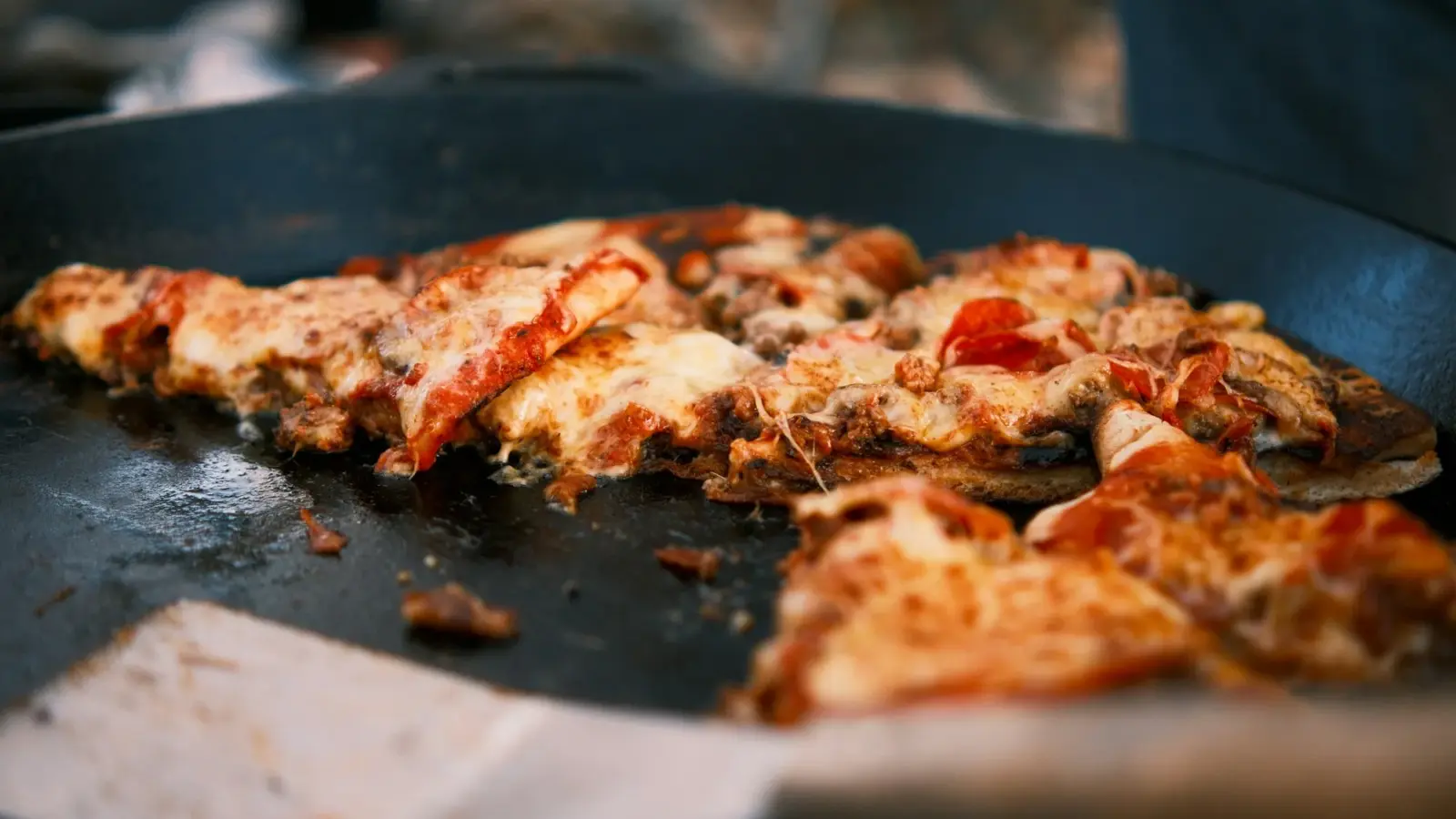
The best way to reheat a slice of pizza is in a covered skillet. Medium-low heat crisps the bottom against the pan while a few drops of water, turned to steam under the lid, melt the cheese, all in 5 to 8 minutes. For more slices than fit in a pan, use the oven: fast on a steel or sheet pan preheated to 450°F (230°C), or slow under foil at 275°F (135°C).
The microwave is the one common method that reliably makes the crust worse. Whatever you use, the safety rules stay the same: refrigerate within 2 hours, eat within 3 to 4 days, reheat to 165°F (74°C).
At a glance
- One to three slices: nonstick or cast-iron skillet, medium-low heat, a few drops of water in the pan, lid on, 5 to 8 minutes.
- A crowd or a whole pie: a steel preheated at 450°F (230°C) for at least 30 minutes (4 to 6 minutes for slices, 8 to 10 for a whole pie), or slices under foil in a 275°F (135°C) oven for 25 to 30 minutes.
- Air fryer: 350°F (175°C) for 3 to 4 minutes, with the crust lightly dampened first.
- Microwave: soggy at first, tough as it cools. A cup of water beside the slice doesn’t fix that.
- Safety: fridge within 2 hours, eat within 3 to 4 days, freeze up to 1 to 2 months for best quality, reheat to 165°F (74°C).
The best ways to reheat pizza, ranked
Every good method does two jobs at once: hard, dry heat for the bottom of the crust and gentler, moister heat for the cheese. The table runs from best to worst for a thin, New York-style slice. The two oven methods tie for second; slice count and thickness decide between them.
| Method | Best for | Heat | Time | What you get |
|---|---|---|---|---|
| Covered skillet, a few drops of water | 1 to 3 slices | Medium-low | 5 to 8 min | Crisp, browned bottom and fully melted cheese |
| Oven, preheated steel, stone or sheet pan | Several slices or a whole pie | 450°F (230°C) | 4 to 6 min for slices on a steel; 8 to 10 min for a whole pie | The crispest bottom; the top dries if left too long |
| Oven, low and slow under foil | A full sheet pan; thick slices | 275°F (135°C), cold start | 25 to 30 min | Evenly heated, crisp underneath, nothing shriveled; slow |
| Air fryer | 1 to 4 slices | 350°F (175°C) | 3 to 4 min | Crisp, but the rim dries and overbrowns easily |
| Toaster oven | 1 or 2 slices | Medium, about 350°F to 375°F (175°C to 190°C) | 3 to 6 min | Good crunch; the top browns fast near the elements |
| Microwave | Speed, nothing else | Full power | About 45 sec | Soggy, then tough within minutes |
Why cold pizza needs heat from below and steam from above
A slice from the fridge is firm mostly because its starches have recrystallized and given up the water they were holding. That process, retrogradation, is the same one that stales bread, and Andrew Janjigian, writing for Serious Eats, notes that it runs fastest just above freezing, which is where your refrigerator sits.
It reverses with heat. King Arthur Baking’s guide to reheating pizza on the stovetop explains that warming the crust to at least 140°F (60°C) lets the starches take the water back up, so the crumb turns tender again.
The hard part is getting there without wrecking what was already cooked. Dry heat crisps the bottom but toughens the rim; moist heat melts the cheese but softens the crust. A covered skillet does both at once: the pan crisps the bottom by direct contact while trapped steam handles the top.
Method 1: a covered skillet with a few drops of water
Use this for one to three slices. The steps are built on America’s Test Kitchen’s tested methods for reviving leftover pizza, and the same idea runs through King Arthur’s and Baking Steel’s guides.
- Put the cold slices in a nonstick or well-seasoned cast-iron skillet with a little space between them. A cold pan is fine; one warmed over medium for a minute or two just gets going sooner.
- Add a few drops of water to an empty spot in the pan, no more than ½ teaspoon (2.5 ml). Keep it off the pizza.
- Cover right away and cook over medium-low heat for 5 to 6 minutes, until the water has evaporated, the toppings are hot and the cheese has melted.
- Uncover. ATK finishes by swirling ½ teaspoon (2.5 ml) of oil into the pan and cooking over medium-high for 1 to 2 minutes, until the bottom is lightly crisp. Without oil, leave the lid off for the same time and check the underside.
King Arthur’s version skips the water: a cold skillet, lid on, medium-low for 6 to 10 minutes, until the cheese sizzles and bubbles. The slice’s own moisture supplies the steam; water just melts the cheese sooner. For several slices, the same piece suggests a griddle with an overturned metal baking pan as the lid.
Warning: Water spits when it hits a hot pan. Drip it in at the edge farthest from your hand and get the lid on quickly. A few drops is plenty; a splash will steam the crust soft.
Method 2: the oven, hot and fast or low and slow
The oven is the answer when you have more slices than fit in a skillet, or a whole pie.
Hot and fast on a preheated steel, stone or sheet pan
This is the slice-shop approach: bake whole pies ahead, then reheat slices to order on the hot floor of a deck oven. PBS NewsHour’s history of how the New York slice became universal credits gas deck ovens with making that possible; the older coal-oven pies, it notes, came out too crisp to reheat. The reheated-to-order slice is still a fixture of the classic neighborhood pizzeria, and part of how New York-style pizza became an American icon.
- Set the steel or stone on the middle rack and heat the oven to 450°F (230°C). Baking Steel’s reheating guide calls for at least 30 minutes, even if the oven says it’s ready sooner, so the steel can soak up heat.
- Slide the slices straight onto the hot surface. One slice takes about 4 minutes, several closer to 6. Take them out when the cheese bubbles and the underside is crisp.
- For a whole pie, launch it with a peel and give it 8 to 10 minutes. If the crust browns before the cheese melts, Baking Steel’s fix is to drop the oven to 400°F (200°C) for about 2 minutes more. If the pie is bigger than your steel, reheat it in slices.
- No steel or stone? Heat a rimmed sheet pan with the oven. It holds far less heat, so plan on 5 to 10 minutes and check the underside.
The same preheating logic drives baking crispy pizza in a home oven, and pizza stone vs. pizza steel walks through which surface to buy.
Low and slow under foil
ATK’s oven method takes longer but needs no attention and handles a full sheet pan. Arrange cold slices on a rimmed baking sheet, cover tightly with foil and set it on the lowest rack of a cold oven. Turn the oven to 275°F (135°C) and heat for 25 to 30 minutes, until the bottom is crisp and the cheese has melted.
The foil keeps the toppings and edges from drying out, the low rack heats from the bottom up, and the gradual start warms the crust evenly. That makes it the best oven choice for thick slices.
Methods 3 and 4: air fryer and toaster oven
Air fryer
An air fryer crisps fast, but ATK warns that its constantly circulating air dries out and overbrowns the crust. Its method puts a little moisture back first:
- Pour a little water into the basket, swirl it around and pour out the excess.
- Dampen the bottom and rim of each slice with wet hands.
- Arrange the slices in a single layer with space between them.
- Heat at 350°F (175°C) for 3 to 4 minutes, until the cheese melts and the edges start to brown.
Thicker slices need a minute or two more. If the rim darkens before the center is hot, lower the heat by 25°F (about 15°C) and go longer.
Toaster oven
Janjigian calls the toaster oven the standard tool for reheating slices. Its elements sit close to the food, so the top browns fast. Preheat it to a medium setting, roughly 350°F to 375°F (175°C to 190°C), with the tray inside so the bottom gets a head start, then heat the slice for 3 to 6 minutes.
Scott Wiener of Scott’s Pizza Tours, quoted in The Takeout, gives the cue: pull it when the top is just about to start bubbling. If the cheese browns before the crust crisps, lay a loose sheet of foil over it.
Method 5: the microwave, and why it goes soggy
A microwave heats the water inside the slice rather than its surface. Steam from the sauce and cheese has nowhere to go but into the crust and onto the plate, and there’s no hot, dry surface to drive it off. ATK sums up the result: mostly soggy straight out of the microwave, then hard and tough as it cools.
In a column on why microwaved bread turns tough, ATK’s Paul Adams explains that microwaves make the water bound to starch boil in scattered pockets, redepositing starch in dense clusters that stiffen as they cool. He cites a study in which microwaved bread came out more than twice as tough as toasted. Pizza crust is no different, so eat a microwaved slice immediately.
Does the cup-of-water trick work?
The popular fix is to microwave the slice next to a cup of water, on the theory that the water absorbs some of the energy so the pizza heats more gently. ATK tried it alongside full power, 50 percent power, a damp paper towel and a bowl over the slice; all gave the same result. If you’re microwaving anyway, keep it simple: slice on a plate or paper towel, full power for about 45 seconds, eat right away.
A better compromise in a hurry: microwave just long enough to warm the toppings, 20 to 30 seconds, then give the slice 1 to 2 minutes in a hot, dry skillet to re-crisp the bottom.
Thin slices, thick slices and frozen pizza
Thin, New York-style slices
Thin slices have little to heat and plenty to lose. Use the fast methods and stop as soon as the cheese melts; every extra minute dries the rim. A plain New York cheese slice is the easiest case, with only sauce and cheese to rewarm.
Thick slices: Sicilian, grandma, pan and deep-dish
A thick square has to heat through before the bottom burns, so turn the heat down. ATK’s foil-covered 275°F (135°C) oven is the safest choice; give a thick Sicilian-style square the full 30 minutes, then check the center. A covered skillet over low heat works too, at the long end of King Arthur’s 6- to 10-minute window. For Chicago deep-dish, a Lou Malnati’s marketing manager told The Takeout in 2021 to use a 350°F (175°C) oven and a cookie sheet, baking until the cheese melts and the center is hot.
Frozen slices
USDA says frozen leftovers can be reheated without thawing; it just takes longer. The easiest route is to thaw slices in the refrigerator overnight, then reheat them like any chilled slice. Straight from the freezer, use moderate heat so the center thaws before the crust scorches: a sheet pan in a 400°F (200°C) oven for about 8 to 10 minutes, until the cheese bubbles, or a covered skillet over medium-low with a few extra minutes under the lid. Either way, the center should reach 165°F (74°C).
Food safety: the 2-hour, 3-to-4-day and 165°F rules
- Refrigerate within 2 hours. USDA’s Food Safety and Inspection Service guidance on leftovers and food safety says cooked food goes into the fridge within 2 hours, or 1 hour above 90°F (32°C). Bacteria grow rapidly between 40°F and 140°F (4°C and 60°C).
- Pizza left out overnight gets thrown away. USDA says to discard perishable food left at room temperature for more than 2 hours, and Clemson University’s Home & Garden Information Center applies that to pizza even when there’s no meat on it.
- Eat it within 3 to 4 days. That’s the refrigerator limit for pizza on FoodSafety.gov’s cold food storage chart, with the fridge at 40°F (4°C) or colder.
- Freeze for 1 to 2 months for best quality. That’s the chart’s freezer time for pizza at 0°F (-18°C). It’s about quality, not safety: food held at 0°F stays safe indefinitely but dries out and loses flavor.
- Reheat to 165°F (74°C). That’s USDA’s target for reheated leftovers; ATK notes 140°F (60°C) is enough to soften a stale crust, but 165°F is the safety number. In a microwave, USDA advises covering and rotating the food, letting it stand, and checking the temperature in several places, because microwaves leave cold spots.
Tip: To check a slice, slide an instant-read thermometer in sideways through the edge so the tip sits in the center, under the cheese. That’s the last spot to heat up.
How to store leftover pizza so it reheats well
Good reheating starts the night before. A cardboard box isn’t airtight, so slices left in it dry out and pick up fridge smells. USDA’s advice for leftovers is to cover them, wrap them airtight or seal them in containers, which keeps bacteria out, holds in moisture and blocks odors. ATK’s reheating methods assume exactly that: pizza stored well wrapped.
- Let the slices stop steaming before you wrap them, but don’t let cooling stretch past the 2-hour mark.
- Wrap slices individually in foil or plastic wrap, or stack them in an airtight container with parchment or wax paper between layers so the cheese doesn’t glue them together.
- To freeze, wrap each slice, set them flat on a tray until firm, then move them to a freezer bag, press out the air and write the date on it.
Note: Pizza finished with uncooked toppings, such as pesto or raw vegetables, doesn’t reheat well. ATK’s advice is to eat those leftovers cold.
Sources
- The Best Way to Revive Leftover Pizza, America's Test Kitchen
- How to reheat pizza, King Arthur Baking (Afton Cyrus, Aug. 7, 2024)
- Can You Toast Bread in the Microwave? (Ask Paul), America's Test Kitchen (Paul Adams, June 21, 2023)
- Leftovers and Food Safety, USDA Food Safety and Inspection Service
- Cold Food Storage Chart, FoodSafety.gov (U.S. Department of Health and Human Services)
- How the New York pizza slice became universal, PBS NewsHour (Nsikan Akpan and Jamie Leventhal, Mar. 15, 2019)
- How to Reheat Pizza in the Oven (So the Crust Is Crispier Than Fresh), Baking Steel (Andris Lagsdin, June 6, 2025)
- Food Safety Answers for College Students, Clemson Cooperative Extension, Home & Garden Information Center
- The Best Way to Reheat Leftover Pizza, According to This Pro Baker (Andrew Janjigian; originally published by Serious Eats), Serious Eats, syndicated on AOL (Aug. 15, 2024)
- What's The Best Way To Reheat Leftover Pizza?, The Takeout (Aimee Levitt, Feb. 12, 2021)
- How to reheat cold pizza, Reviewed (Connor Whooley, May 14, 2019)
- The Best Way to Reheat Pizza, TODAY (Joey Skladany, updated Jan. 6, 2023)
- You Can (And Should) Be Freezing Those Costco Pizza Leftovers, Food Republic (Betsy Parks, Dec. 12, 2024)