The Anatomy of a Classic Neighborhood Pizzeria
The deck oven, the glass case, the menu board, the box and the price of a plain slice: how each part of a New York-style slice shop earns its place.
A classic neighborhood pizzeria is built to sell pizza one slice at a time, quickly and all day. The gas deck oven, the glass case of whole pies on the counter, the crowded menu board, the dough mixed every day, the stack of flat boxes and the row of shakers each solve a specific problem in that business.
The template took shape in New York City around World War II and has since spread well beyond the city. What follows takes the shop apart piece by piece, then looks at what the price of a plain slice says about the money behind it.
At a glance
- The oven: A gas-fired deck oven, usually run at about 500–550°F (260–290°C), bakes whole pies and recrisps single slices in a couple of minutes.
- The case: Pre-baked pies wait under glass on the counter, so a slice can be reheated and handed over in minutes.
- The box: An early vented, stackable pizza box was patented in 1964 for Chicken Delight; the plastic “package saver” that keeps the lid off the cheese was patented in 1985.
- The price: A plain slice tracked the New York subway fare for decades. By late 2025, Gothamist put the median plain slice at about $3.81, against a $3 fare from January 2026.
The gas deck oven, and why your slice goes back in
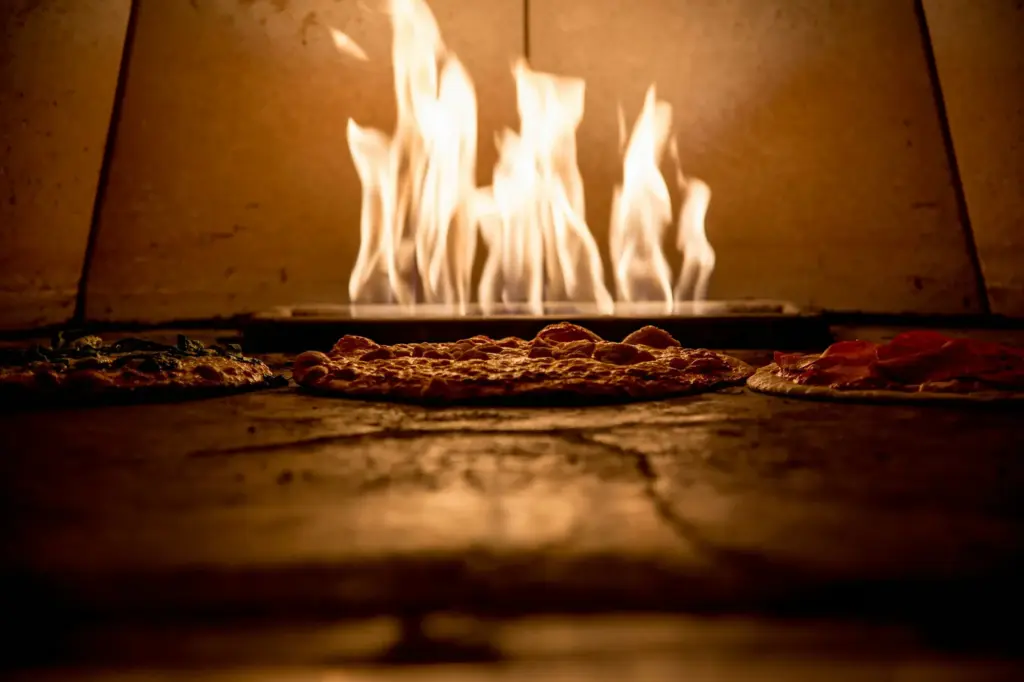
The biggest thing behind the counter is usually a deck oven: a steel cabinet holding one or more flat stone baking decks, heated by gas burners below. Pies bake directly on the hot stone. Food Republic’s guide to New York pizza styles puts the usual slice-shop bake at around 500–550°F (260–290°C), against the 800–1,000°F (430–540°C) it cites for coal ovens.
That gentler heat is what turned the slice into a business. Gas ovens reached pizzerias around the early 1940s, and Scott Wiener of Scott’s Pizza Tours argues that because they heat indirectly and run much cooler than wood or coal ovens, they made selling pizza by the slice viable. Our history of how New York-style pizza became an American icon covers who built those ovens and how the slice shop took over after the war.
Why the slice is reheated
A slice shop bakes whole pies ahead and sells them in pieces. Order a plain slice and the counter worker takes one from a pie in the case and slides it back onto the deck for a couple of minutes, the routine described in an episode of King Arthur Baking’s Things Bakers Know podcast devoted to the New York slice. Many shops set aside a second oven, or one deck, for re-crisping and run it slightly cooler than the baking deck.
The reheat is part of the style, not a shortcut around it. Because the first bake is moderate, Food Republic explains, the crust holds on to moisture, so a slice can wait in a display case and go back into the oven without turning dry, brittle or hard. The second trip across hot stone crisps the underside again and remelts the cheese.
A well-reheated slice has a crackly bottom, a pliable middle and cheese that is molten rather than browned to leather. At home, a preheated skillet or pizza steel does the deck’s job; our guide to reheating pizza with a crisp crust covers the options.
The counter and the glass case
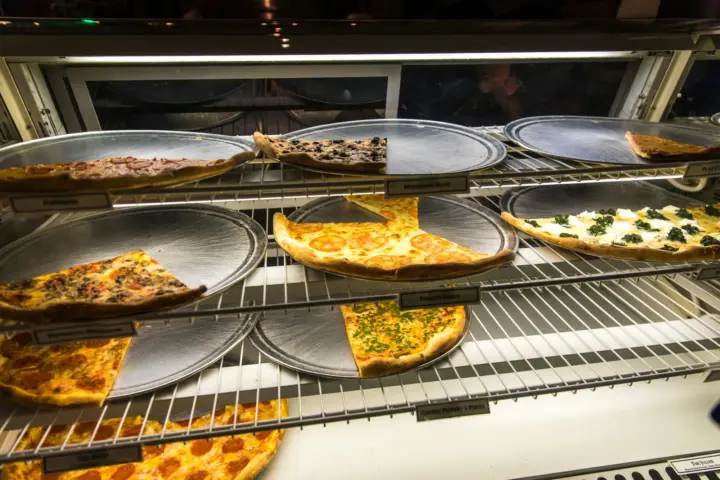
The counter is where the business model shows. Whole pies sit in a glass case: plain cheese, pepperoni, a Sicilian tray, perhaps a white pie or a house specialty. Each one is a menu and an inventory count at the same time. You point, and the counter worker cuts, reheats and plates.
The case is what lets one oven serve a lunch line and a lone customer at 3 p.m. with the same speed. Baking a pie to order takes several minutes; a pie already in the case turns the sale into a two-minute transaction. The slice comes out large, on a paper plate, and often leaves in the customer’s hand, which is why, as Food Republic notes, the crust has to fold lengthwise and still hold its toppings.
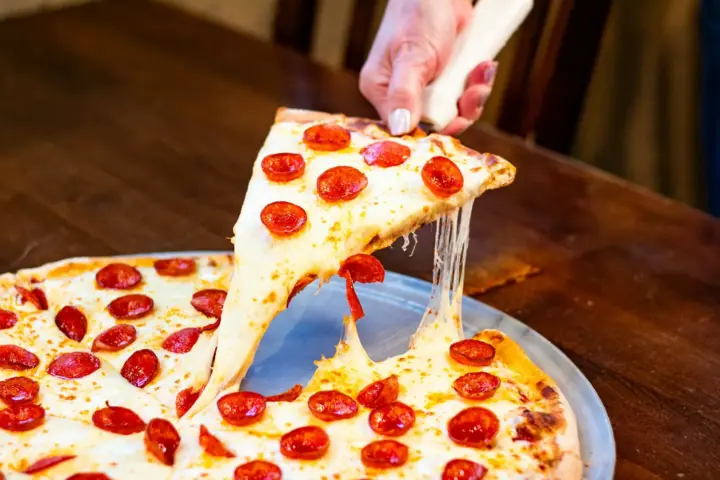
The plain slice is the benchmark. It is usually the cheapest pizza on the board and the one people judge a shop by: thin and wide, with a light layer of tomato sauce, shredded low-moisture mozzarella and a crust that folds without cracking. Our recipe for a classic New York cheese pizza rebuilds that pie for a home oven.
Reading the menu board
Above the counter, the menu board usually runs well past pizza. The lineup tends to repeat from shop to shop, and nearly everything on it reuses the same dough, sauce, cheese and oven.
Round slices and the Sicilian square
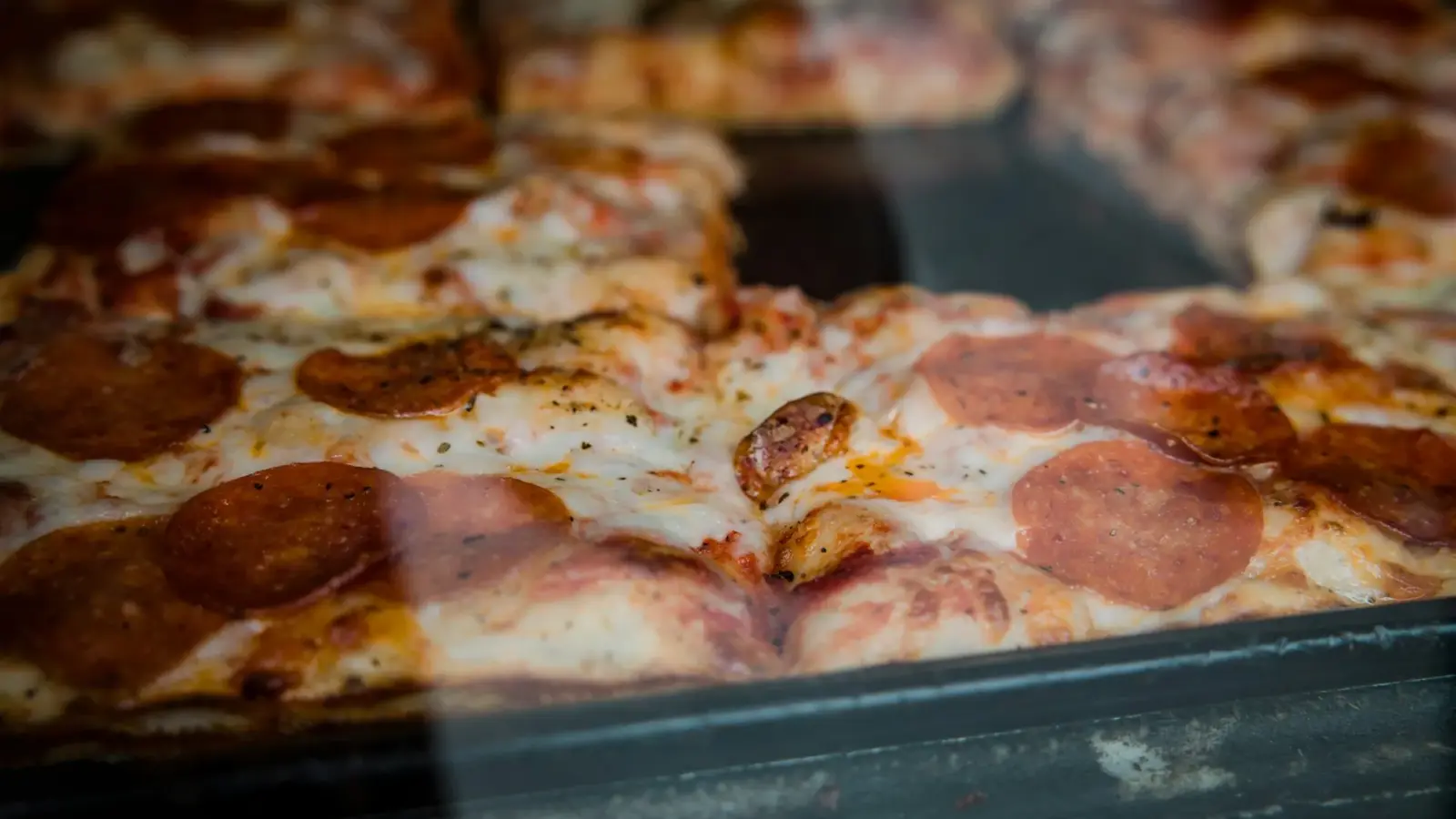
Round slices come plain or topped, and the same pies are sold whole. The other fixture is the Sicilian square. In American pizzerias, Sicilian pizza is a thick, rectangular pie descended from Palermo’s sfincione; Food Republic describes a dough that proofs for a long time before it is pressed into an oiled pan, so it bakes up tall and airy. Some pizzerias put the cheese under the sauce to keep the crust crisp. It is cut into squares rather than wedges and reheats on the same deck as everything else.
Heroes, garlic knots, calzones and rolls
Hero is the New York name for a big sandwich on a long roll or loaf. The earliest printed “hero sandwiches” that word researcher Barry Popik has found date to 1934, in an Associated Press item in Albany’s Evening News. At a pizzeria the heroes are usually the hot kind, built from what the kitchen already has: meatballs, sausage and peppers, breaded chicken or eggplant, tomato sauce and mozzarella.
Garlic knots, calzones and rolls are pizza dough in other shapes. Knots are short ropes of dough tied, baked and tossed in garlic butter; their origin is disputed, and our homemade garlic knots recipe covers the competing stories along with the method. A calzone is a round of dough folded into a half-moon over ricotta and mozzarella and baked sealed. Rolls wrap sausage, pepperoni or chicken in a log of dough and are sold by the piece. Each one turns dough and toppings the shop already stocks into another sale.
Dough is a daily job
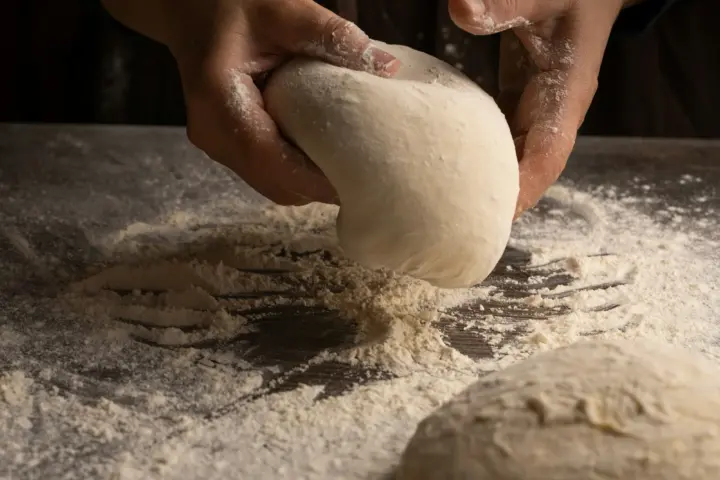
In a busy pizzeria, making dough is daily work: a large batch of high-gluten or bread flour, water, salt, yeast and usually a little oil and sugar, divided into balls and stacked in covered dough boxes in the walk-in. Daily does not mean same-day, though. New York-style dough usually gets a cold rest of at least 24 hours, as the same King Arthur podcast points out, so today’s batch is often tomorrow’s pizza.
The cold rest slows the yeast, giving flavor time to develop and making the dough easier to stretch. Cold dough is too firm to open, so it has to warm up first. Tom Lehmann, writing in his dough column for PMQ Pizza, notes that dough usually leaves the cooler at 40°F (4°C) or lower and recommends letting the balls reach an internal 50°F (10°C), which leaves a working window of about 2½ to 3 hours.
The home-kitchen version of that process is our New York-style pizza dough, which runs the same cold ferment in a refrigerator.
Red pepper, oregano, garlic powder and grated cheese
The shakers on the counter let each customer finish a slice to taste. The usual set is crushed red pepper flakes, dried oregano, garlic powder and grated hard cheese, often a Parmesan- or Romano-style blend. A plain slice is a simple thing, and the shakers add what it leaves out: heat, a dry herbal note, extra savoriness and salt.
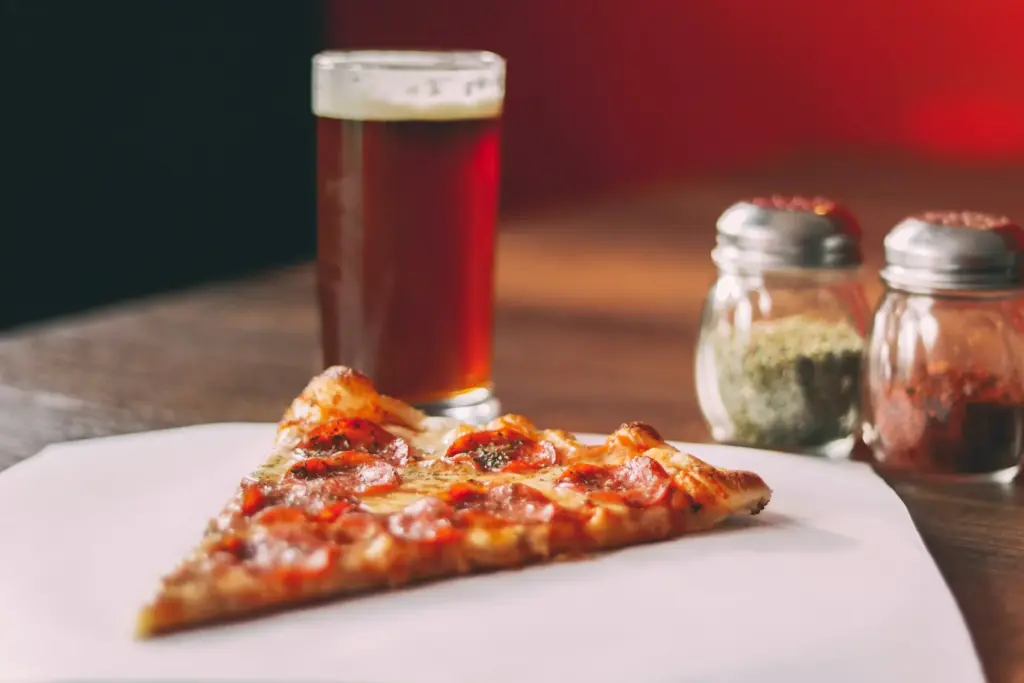
Oregano’s place on that counter is younger than it looks. NPR, citing food historian John F. Mariani, reports that US oregano sales rose 5,200 percent between 1948 and 1956, after American soldiers who fought in Southern Italy came home with a taste for the “pizza herb.” Before the war, NPR notes, oregano was already central to the cooking of New York’s largely Southern Italian immigrants. The war carried it to everyone else.
Takeout, delivery and the pizza box
Much of a neighborhood pizzeria’s business leaves the building: slices to go, whole pies carried home and delivery to the surrounding streets. Orders that once came in by phone now also arrive through delivery apps. The constant is the box.
A pizza box has one main enemy, which is steam. An early US patent for a pizza box, filed in February 1963 by Abraham L. Tunick and assigned to Chicken Delight Inc. of Rock Island, Illinois, put the problem plainly: the crust “becomes soggy when enclosed hot in a box.” Tunick’s “Container” patent, granted in December 1964, describes a folding paperboard box that stores flat, with vent holes in the top and tabs that stand up so stacked boxes cannot block one another’s vents. Store flat, fold fast, stack and vent: that is still the brief.
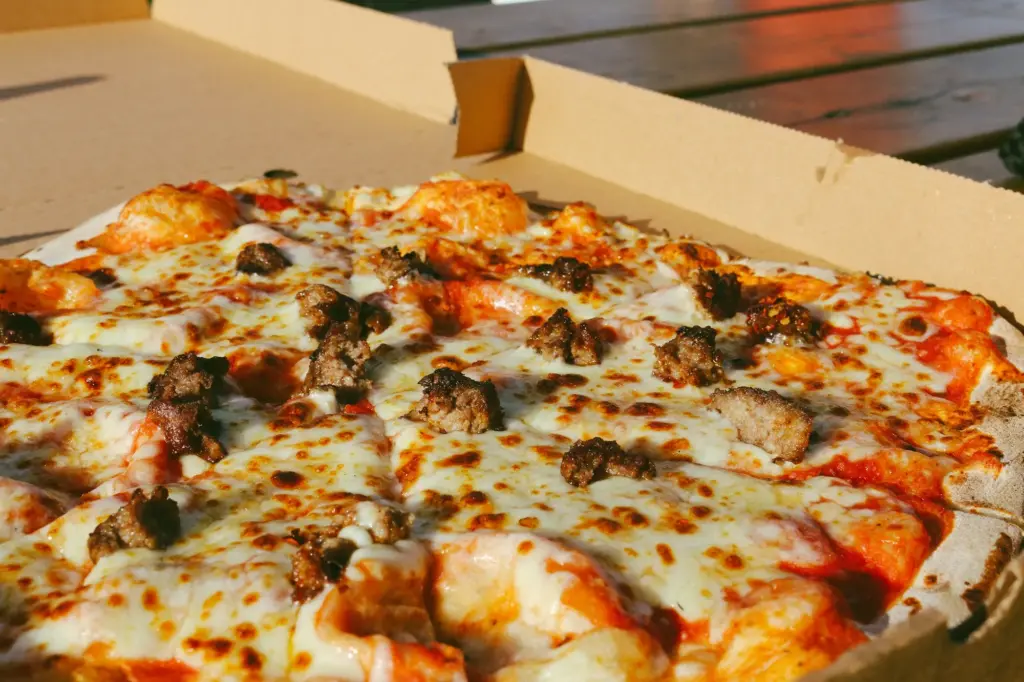
The little plastic tripod in the middle of a delivery pie has its own patent. Carmela Vitale filed for a “package saver” in February 1983 and received the patent in February 1985. It describes a molded plastic support that keeps a large box lid from sagging onto a pizza or a cake. According to its legal-status record, the patent lapsed in 1993 after the maintenance fees went unpaid.
The economics of the slice
For decades, the price of a plain slice in New York tracked the subway fare closely enough to earn a name. In 1980, Eric Bram pointed out that since the early 1960s the slice had “matched, with uncanny precision, the cost of a New York subway ride,” as VICE recounted in 2016. He even used it to forecast: with a decent slice under 60 cents getting hard to find, he argued, the 50-cent fare was doomed. The observation became known as the Pizza Principle.
It was a joke with a good track record, not an economic law. VICE dates the first wobble to the discounted MetroCard fares of the mid-1990s, yet the match kept roughly holding. In 2014, data scientist Jared Lander analyzed 651 plain-slice prices from MenuPages menus in Manhattan, Brooklyn and Queens and found an average of $2.33 and a median of $2.45, against a $2.50 base fare that came to about $2.38 with the MetroCard bonus then on offer.
The break came after the pandemic. In December 2025, Gothamist reported the principle’s demise, putting the median plain slice at about $3.81 based on visits to dozens of shops, with the MTA set to raise the base fare to $3 on January 4, 2026. As of October 2026, the MTA lists the fare at $3. Lander told Gothamist that post-pandemic inflation had pushed up the cost of a slice faster than the MTA raised fares. The transit agency works to hold the fare down; a shop owner has no such cushion.
Cheese is a big part of that squeeze. In March 2023, 2 Bros. Pizza raised its famous dollar slice to $1.50 at all of its New York City locations, ABC7 reported. Co-owner Eli Halali told the New York Post the chain could no longer break even, and Entrepreneur reported his estimate that cheese made up roughly 40 percent of its food costs.
The arithmetic shows why shops guard the plain-slice price so closely. Cut a classic 18-inch (46 cm) pie into eight slices and sell them at $3.81 each, and the pie brings in about $30; every 25-cent increase adds $2 per pie. That money has to cover cheese, flour, an oven burning gas all day, rent and wages.
Note: Slice prices vary widely by neighborhood and by shop. The figures above are dated snapshots, a 2014 menu analysis and a 2025 count, not a citywide price index.
The template holds well beyond the five boroughs. Our look at pizza culture in Albany, New York finds Capital Region menus that would look familiar to anyone who grew up near a New York City slice counter.
Sources
- The Difference Between NYC's 4 Most Common Styles Of Pizza (Andrea Carlo, Aug. 1, 2026), Food Republic
- When did we start folding pizza? (Scott Wiener, Nov. 29, 2015), Scott's Pizza Tours
- New York Pizza: the Iconic Slice, with Wylie Dufresne (Things Bakers Know podcast, episode 18; hosts David Tamarkin and Jessica Battilana), King Arthur Baking
- Your Guide To The 4 Most Common Types Of NYC-Style Pizza (Jessica Riggio, Apr. 14, 2026), The Takeout
- Check Your Dough's Temperature Before Opening It Into Skins (Tom Lehmann, In Lehmann's Terms, June 18, 2019), PMQ Pizza Magazine
- Hero Sandwich (The Big Apple; earliest citation: Albany Evening News, June 6, 1934), Barry Popik
- GIs Helped Bring Freedom To Europe, And A Taste For Oregano To America (Nina Martyris, May 9, 2015), NPR, The Salt
- US Patent 3,163,344, Container (Abraham L. Tunick, assigned to Chicken Delight Inc.; filed Feb. 18, 1963, granted Dec. 29, 1964), Google Patents
- US Patent 4,498,586, Package saver (Carmela Vitale; filed Feb. 10, 1983, granted Feb. 12, 1985), Google Patents
- What the Price of a Slice of Pizza Can Tell You About New York (Alex Swerdloff, Mar. 14, 2016), VICE (Munchies)
- Average Cost of a New York Slice in 2014 (Jared Lander, May 23, 2014), Jared Lander
- NYC slices now far more expensive than subway fare as 'pizza principle' disappears (Liam Quigley, Dec. 29, 2025), Gothamist
- Fares (base fare $3, checked October 2026), Metropolitan Transportation Authority (MTA)
- The $1 Slice Becomes the Latest Victim of Inflation (Emily Rella, Mar. 23, 2023), Entrepreneur
- NYC's 2 Bros. Pizza locations no longer selling $1 slices (Mar. 21, 2023), ABC7 New York