Homemade Garlic Knots with Garlic Butter
One batch of New York-style pizza dough makes 20 chewy, deep-golden knots, tossed straight from the oven in butter, olive oil, garlic and Parmesan.
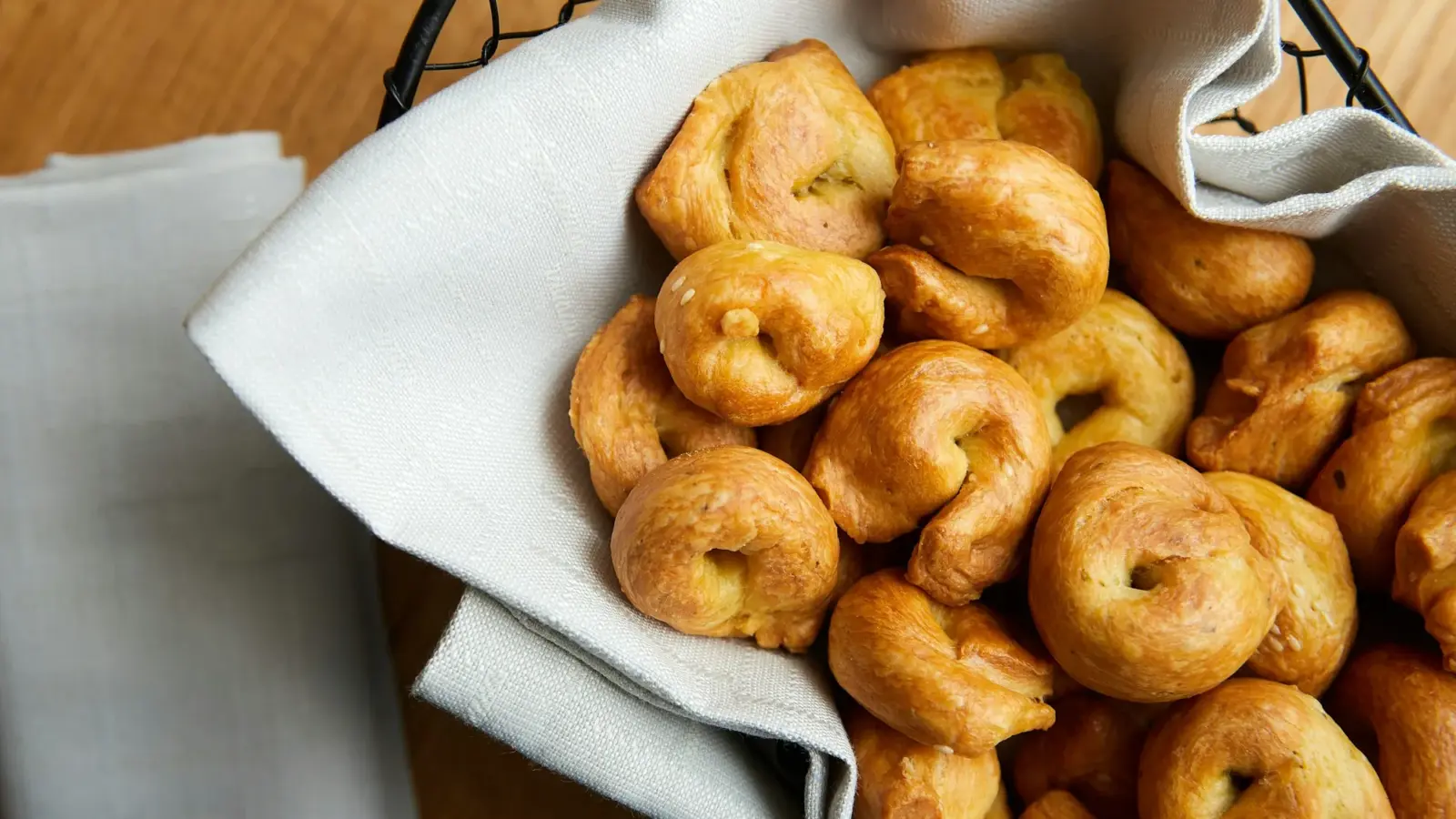
Pizzeria garlic knots are pizza dough and nothing fancier: short ropes tied in a loose knot, baked until deep golden and tossed while still hot in butter and olive oil with gently cooked garlic, parsley and Parmesan. One batch of our New York-style pizza dough, 760 g, makes 20 two-bite knots at 38 g each.
From refrigerator to table takes about two hours, mostly hands-off. A 1-pound (454 g) bag of store-bought dough makes 12 of the same knots.
Why pizza dough makes the best garlic knots
A dinner-roll dough enriched with milk, butter and sugar bakes up soft and sweet. Pizza dough is leaner. Ours runs 62% hydration with 2.4% salt and just 2% each of olive oil and sugar, so knots made from it come out crisp outside and chewy inside, sturdy enough to take a bath of garlic butter without going soggy. America’s Test Kitchen pitches the ideal knot as chewier than a dinner roll and fluffier than pizza crust, which is where a well-proofed knot of cold-fermented New York-style dough lands.
Who tied the first one is disputed, but thrift is the usual explanation. A 2014 amNY recipe column says that, depending on whom you ask, “a frugal pizzaiolo” in Ozone Park, Queens, or in Plainview or Syosset on Long Island came up with them in the late 1970s to use up leftover dough. Other accounts reach back to 1940s Brooklyn. None of the claims has been proved.
How many garlic knots a batch of dough makes
Portion by weight, not by eye. Knots of the same weight finish at the same moment; eyeballed pieces leave some doughy inside while their neighbors overbrown. Pick a size, divide your dough weight by it and roll every rope to the same length.
| Knot size | Dough per knot | From a 760 g batch | From 1 lb (454 g) dough | Rope length |
|---|---|---|---|---|
| Snack | 30 g (1 oz) | 25 | 15 | 7 in (18 cm) |
| Pizzeria (this recipe) | 38 g (1⅓ oz) | 20 | 12 | 8–9 in (20–23 cm) |
| Dinner roll | 50 g (1¾ oz) | 15 | 9 | 10 in (25 cm) |
One 380 g dough ball makes 10 knots at the recipe size. Adjust the bake by a couple of minutes for smaller or larger knots.
Tip: Divide the dough straight from the refrigerator. Cold dough is firm and barely sticky, so it cuts cleanly with a bench scraper, and the small pieces lose their chill in 30 to 45 minutes.
How to tie a garlic knot
Roll each piece into a 3-inch (8 cm) log, cover the logs and rest them until the dough is no longer fridge-cold and the gluten has relaxed. A rope that keeps shrinking back needs another 5 to 10 minutes, the same snap-back covered in our guide to stretching pizza dough without tearing it.
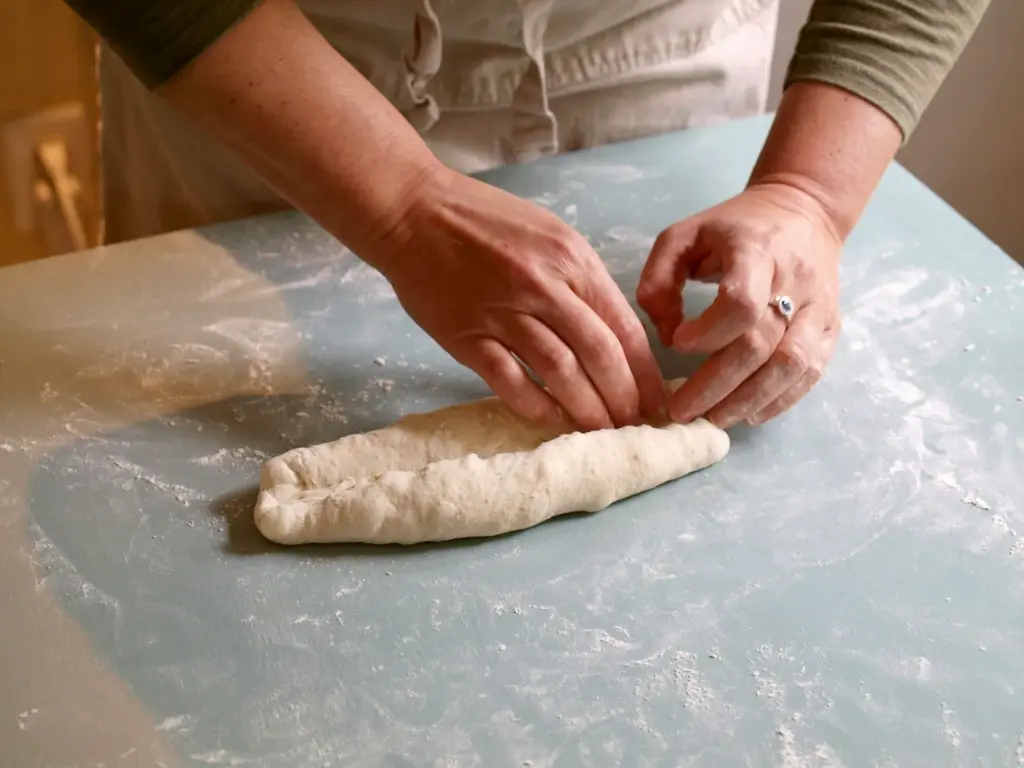
Roll on a bare, unfloured counter; flour makes the dough skid instead of lengthen. Start with both hands at the center and move them outward until the rope is 8 to 9 inches (20 to 23 cm) long and about ⅝ inch (1.5 cm) thick.
Cross the rope into a loop, pass one end through and pull gently, leaving two stubby tails about 1 inch (2.5 cm) long: the classic pizzeria knot. For a rounder roll, tuck one tail underneath and poke the other up through the center. Keep it loose. A tight knot has no room to expand, and the middle bakes up dense.
A short proof and a hot oven
The dough did its real rising in the refrigerator, so the knots need only 20 to 30 minutes at room temperature, loosely covered, while the oven heats. They are ready when they look puffy, roughly half again their size, and a gentle poke springs back slowly. Much longer and they slump into blobs.
Bake at 425°F (220°C) on parchment-lined sheet pans. High heat browns the outside before the inside dries out; at 400°F (200°C) the knots take a few minutes longer and come out softer and paler. Count on 15 to 18 minutes, switching and rotating the pans halfway, and go by color: deep golden on top, browned underneath, a shade darker than feels right. Pale knots are still gummy inside, and the butter turns them soggy. The center should read about 190°F (88°C), the point at which King Arthur Baking says most loaves and rolls are done.
The garlic butter, and why you toss the knots hot
Butter brings the flavor. Olive oil, liquid at room temperature, keeps the coating glossy instead of setting into a waxy film as the knots cool. For its own knots, America’s Test Kitchen passed over garlic powder and raw garlic in favor of fresh garlic cooked in butter, and that is the approach here.
Cook the garlic in the fat over low heat for 2 to 4 minutes, until it smells sweet and turns soft, with a quiet sizzle and no color. Rush it and the garlic, low in water and relatively high in sugar, scorches and turns “acrid and bitter,” as America’s Test Kitchen warns.
Toss, don’t brush. Tip the knots from the oven straight into a large bowl, pour the warm garlic butter over and toss. The hot crust drinks it in; on cooled knots it sits on the surface and tastes greasy. Add the Parmesan and parsley once every knot is slick, so the cheese clings to the bread instead of clumping in the butter. The Parmesan supplies most of the salt, so the butter needs only a pinch.
Food safety: Don’t leave garlic butter or garlic oil sitting out after serving. Low-acid garlic covered in fat can support botulism, and Oregon State University Extension advises keeping homemade garlic and herb oils in the refrigerator for no more than 4 days, or freezing them. Treat garlic butter the same way.
Pizzeria-Style Garlic Knots
Twenty 38 g knots of cold-fermented New York-style pizza dough, baked at 425°F (220°C) until deep golden and tossed hot in garlic butter, parsley and Parmesan.
- Prep
- 30 min
- Cook
- 20 min
- Rest for the divided dough (up to 45 minutes) and proof (up to 30 minutes); dough made 1 to 3 days ahead
- 1 hr 15 min
- Total
- 2 hr 5 min
- Yield
- 20 garlic knots
- Serves
- 8
- Oven
- 425°F (220°C), racks in the upper and lower thirds
Ingredients
Knots
Garlic butter
To finish
Equipment
- Digital kitchen scale
- Bench scraper
- Two rimmed half-sheet pans (18 x 13 in / 46 x 33 cm)
- Parchment paper
- Plastic wrap or clean kitchen towels
- Small saucepan
- Large mixing bowl
- Instant-read thermometer (optional)
Instructions
- Divide the dough Turn the cold dough out onto an unfloured counter. Using a bench scraper and a scale, cut it into 20 pieces of 38 g each.
- Pre-shape and rest Roll each piece under your palm into a 3-inch (8 cm) log. Set the logs on a lightly oiled tray, cover with plastic wrap and rest 30 to 45 minutes, until no longer cold and a log stretches without springing back.
- Roll the ropes On the unfloured counter, roll each log from the center outward into an 8- to 9-inch (20 to 23 cm) rope about ⅝ inch (1.5 cm) thick. If a rope shrinks back, leave it 5 to 10 minutes and roll the next one.
- Tie the knots Tie each rope into a loose knot with two 1-inch (2.5 cm) tails; for a rounder knot, tuck one tail under and the other up through the center. Set 10 knots on each parchment-lined sheet pan, about 2 inches (5 cm) apart.
- Proof and preheat Cover loosely and proof at room temperature 20 to 30 minutes, until puffy and a gentle poke springs back slowly. Meanwhile, set racks in the upper and lower thirds and heat the oven to 425°F (220°C).
- Make the garlic butter In a small saucepan over low heat, melt the butter with the olive oil. Add the garlic and red pepper flakes and cook gently, stirring, 2 to 4 minutes, until fragrant and soft but not browned. Off the heat, stir in the salt and keep warm.
- Bake Bake at 425°F (220°C) for 15 to 18 minutes, switching and rotating the pans halfway, until the knots are deep golden brown on top and browned underneath. The center of a knot should read about 190°F (88°C).
- Toss in garlic butter Immediately transfer the hot knots to a large bowl. Stir the garlic butter, pour it over and toss gently until every knot is coated.
- Finish and serve Add the Parmesan and parsley and toss again. Serve hot or warm with marinara for dipping, spooning any garlic butter left in the bowl over the top.
Notes
- Half batch: one 380 g dough ball makes 10 knots; halve the garlic butter and toppings.
- Store-bought dough: 1 lb (454 g) makes 12 knots. Use 3 tablespoons (42 g) butter, 2 tablespoons (30 ml) olive oil, 4 teaspoons (19 g) garlic, ⅓ cup (30 g) Parmesan, 4 teaspoons (5 g) parsley, a pinch of salt and, if you like, a pinch of red pepper flakes.
- Make ahead: refrigerate shaped, covered knots up to 24 hours; let them sit out 45 to 60 minutes, until puffy, before baking. Garlic butter keeps 4 days refrigerated.
- Leftovers: refrigerate within 2 hours and eat within 3 to 4 days, or freeze up to 3 months. Reheat at 350°F (175°C) for 5 to 8 minutes.
The store-bought dough shortcut
A 1-pound (454 g) bag of refrigerated supermarket pizza dough, or a dough ball from a pizzeria that sells them, makes 12 knots at 38 g. Divide it cold, rest the pieces until they lose their chill, then shape and bake exactly as above; the recipe notes give a scaled-down garlic butter. If the dough sticks, oil your hands lightly rather than adding flour.
Knots also rescue homemade dough that went slack and gassy after a day too long in the fridge: too weak for a thin 14-inch round, it still rolls into short ropes.
Common garlic knot mistakes
- Knots tied too tight. The center stays dense and doughy. Leave a little slack.
- Uneven pieces. Small knots overbrown while big ones stay raw inside. Weigh each piece.
- Browned garlic. It turns bitter and flavors the whole batch. Keep the heat low and take the pan off as soon as the garlic smells sweet.
- Coating cool knots. The butter sits on top. Toss them within a minute or two of leaving the oven.
Variations and what to serve with garlic knots
- Pull-apart knots: Set 10 shaped knots (one dough ball’s worth) close together in a buttered 10-inch (25 cm) cast-iron skillet and proof until they touch. Crowded knots brown more slowly, so bake at 425°F (220°C) for about 20 to 25 minutes, until the top is deep golden and a center knot reads 190°F (88°C), then spoon the garlic butter over them in the pan.
- Sharper and hotter: Swap half the Parmesan for saltier Pecorino Romano, skip the added salt and use the full ½ teaspoon of red pepper flakes.
Serve the knots warm with a bowl of homemade marinara for dipping, the classic pairing, or with a ramekin of our simple pizza sauce left over from pizza night. They also make a natural side for a New York cheese pizza: one dough ball becomes the pie, the other becomes 10 knots.
Make-ahead, storage and reheating
Making them ahead
Shape the knots, cover the pans well and refrigerate for up to 24 hours, the window America’s Test Kitchen gives for its knots. Let them sit at room temperature 45 to 60 minutes, until puffy, then bake as usual. The garlic butter can be made up to 4 days ahead and refrigerated; warm it gently before tossing.
For a party, bake the knots plain up to 4 hours ahead and leave them on a rack, then rewarm at 350°F (175°C) for about 5 minutes and toss in warm garlic butter just before serving.
Storing leftovers
Refrigerate leftover knots in an airtight container within 2 hours and eat them within 3 to 4 days, following University of Illinois Extension guidance on leftovers. To freeze, cool them completely, bag them with the air pressed out and use within about 3 months for best quality, the short end of the 3- to 6-month range the University of Arkansas extension service gives for yeast breads and rolls.
Reheating
Skip the microwave, which leaves bread tough once it cools. Reheat refrigerated knots on a sheet pan at 350°F (175°C) for 5 to 8 minutes, until hot through and crisp outside. Thaw frozen knots in their bag at room temperature for about an hour, wrap them in foil and warm at 300°F (150°C) for 5 to 10 minutes, opening the foil for the last couple of minutes. As with reheating pizza so the crust stays crisp, dry heat beats steam.
Sources
- Garlic Knots (recipe; texture goal, fresh garlic cooked in butter, 24-hour make-ahead), America's Test Kitchen
- Wait! Don't Add Your Garlic Just Yet (Sept. 14, 2023), America's Test Kitchen
- Garlic knot recipe (Lauren Chattman, Nov. 6, 2014), amNY
- Garlic knot (states a 1940s Brooklyn origin, uncited; notes many pizzerias claim the invention), Wikipedia
- Where else but NYC, Amirite? The Obscure History and Origin of Garlic Knots (Jan. 20, 2018; competing 1947 Brooklyn and 1973 Queens claims, none proved), Spoiled NYC
- Using a thermometer with yeast bread (PJ Hamel, Apr. 7, 2017), King Arthur Baking
- Ingredient Weight Chart (butter, olive oil, grated Parmesan, minced garlic, salts), King Arthur Baking
- Garlic knot for the faint of heart (tucked-knot shaping, 2008), King Arthur Baking
- Herbs and vegetables in oil, Oregon State University Extension Service
- Leftovers (Food Safety), University of Illinois Extension
- Cooking Ahead for the Holidays: Breads (Katie Cullum), University of Arkansas System Division of Agriculture, Cooperative Extension Service