Spaghetti and Meatballs: A Home-Cooked Classic
A milk-soaked bread panade keeps beef-and-pork meatballs tender as they brown, then simmer to 160°F (71°C) in a sauce of whole peeled tomatoes.
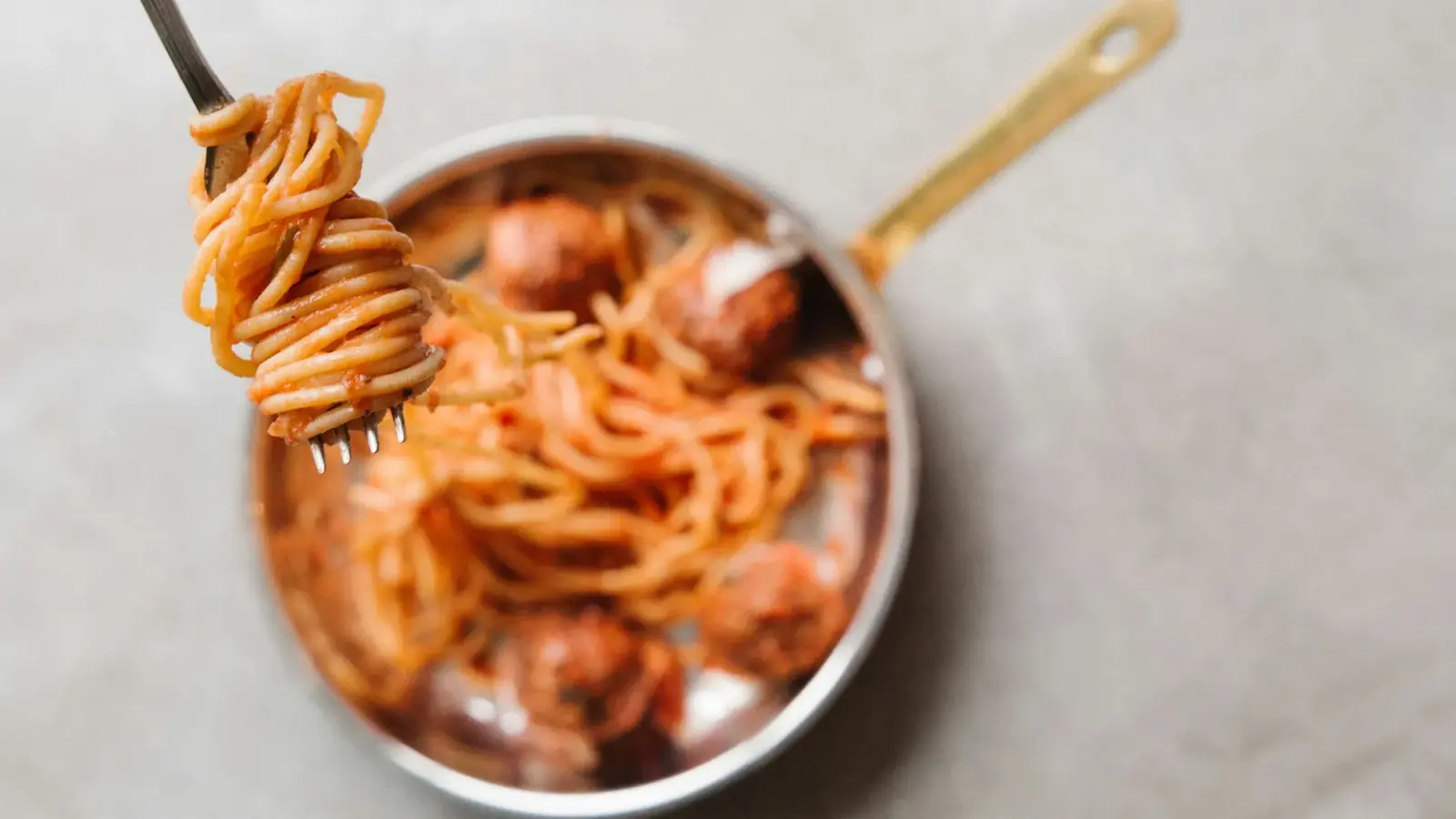
Tender meatballs come from three things: bread soaked in milk worked into the meat, a light hand when mixing and rolling, and a gentle finish in simmering tomato sauce rather than a hard sear. Brown about 36 meatballs, simmer them in a sauce of whole peeled tomatoes until the centers reach 160°F (71°C), and toss a pound of spaghetti in some of that sauce.
The recipe serves 6 in a little under 2 hours, much of it hands-off simmering. The meatballs freeze well raw or cooked, so a double batch makes sense.
What keeps meatballs tender
Ground meat tightens as it cooks: its proteins shrink, squeeze out juice and bond into a firm, springy mass. Good for sausage, bad for meatballs. A panade, bread soaked in milk, gets in the way. The soaked crumbs hold onto liquid and sit between the bits of meat so the proteins can’t knit tightly.
Fresh bread makes the softest panade. Mash the crumbs and milk into a smooth paste, then stir in the eggs, cheese, garlic, parsley and seasoning before any meat goes in. With everything already spread through the paste, the meat needs only about a minute of gentle mixing by hand.
Beef, pork or all beef
Beef carries the flavor; pork, milder and usually fattier, makes the texture softer and juicier. The card’s 3-to-1 split gives a beefy meatball, and an even split is softer still. All beef works, but don’t go leaner than 85 percent or the meatballs cook up dry. Meatloaf mix of beef, pork and veal is a good shortcut.
Weigh the salt if you can: 8 grams seasons the batch. That’s 1 tablespoon of Diamond Crystal kosher but only 1½ teaspoons of the denser Morton.
Tip: Before rolling, fry a teaspoon of the mixture in a little oil and taste it. Fix the salt now; once three dozen meatballs are rolled, it’s too late.
Roll with wet hands, about 1¼ ounces (35 g) per meatball, roughly 1½ inches (4 cm) across, without squeezing. If the mixture slumps, chill the rolled meatballs for 15 to 30 minutes before browning.
Brown first, then finish in the sauce
Browning builds a crust and leaves browned bits in the pot that dissolve into the sauce; it isn’t meant to cook the meatballs through. The centers finish in barely simmering sauce, where gentle heat keeps them tender while meat and tomatoes trade flavor for half an hour.
Brown in batches of about 12. Crowd the pot and the meatballs steam gray instead of browning. Leave each batch alone for the first 2 minutes; a meatball that sticks when nudged isn’t ready to turn.
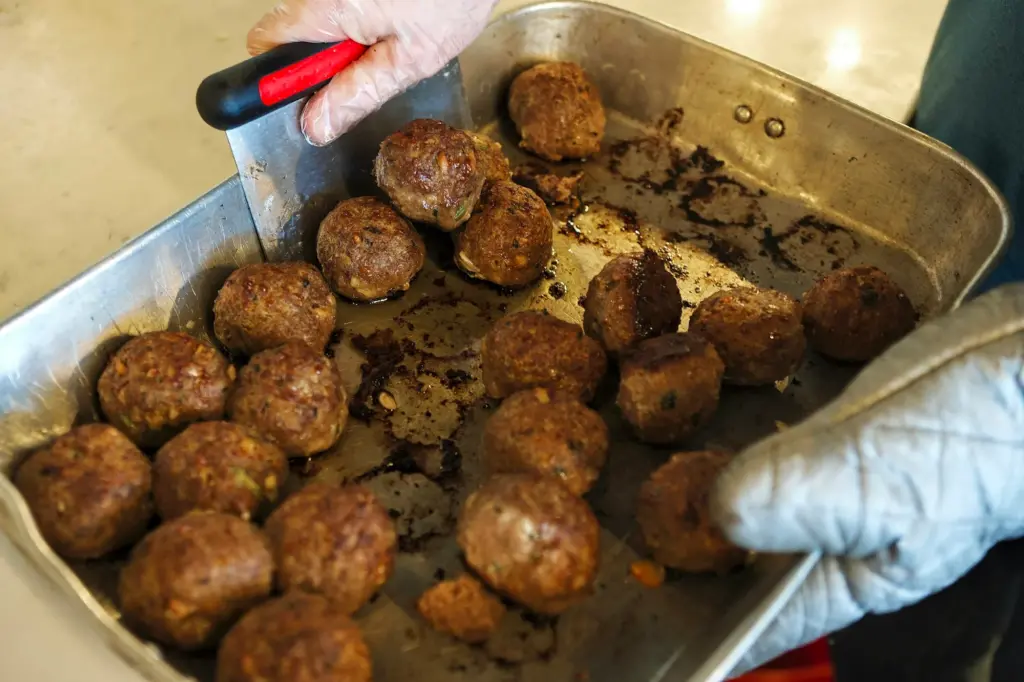
For less mess, bake them all at once at 425°F (220°C), as in the recipe notes. You trade some browned bits and get slightly flat bottoms, but nothing splatters.
Food safety: Ground beef and pork must reach 160°F (71°C), per the FoodSafety.gov safe minimum temperature chart. Use an instant-read thermometer in the center of the largest meatball, not color: the USDA warns that ground beef can turn brown before it’s safely cooked.
A sauce built from whole peeled tomatoes
Whole peeled tomatoes, crushed by hand, give the sauce body and soft pieces of tomato; canned crushed tomatoes vary widely from brand to brand. Our guide to pizza sauce and canned tomatoes covers choosing a brand and what “San Marzano DOP” on a label guarantees.
The sauce starts in the pot the meatballs browned in and simmers about 40 minutes in all, 25 to 30 of them with the meatballs. That puts it between a quick marinara and an all-afternoon Sunday gravy, a range our homemade marinara article compares. With about 5 cups (1.2 liters) of marinara on hand, skip the sauce steps and simmer the browned meatballs in it.
Salt lightly and adjust at the end: canned tomatoes range from unsalted to well seasoned, and the meatballs season the sauce as it reduces.
Cooking and saucing the spaghetti
Start the pasta water when the meatballs go back into the sauce. Skip the oil in the water; it coats the strands so the sauce slides off. Save a cup of the starchy cooking water instead; it helps the sauce cling and thicken.
The spaghetti comes out a minute short of al dente and finishes in about 2½ cups (600 ml) of sauce, loosened with splashes of the reserved water until every strand is coated. Plain spaghetti with sauce ladled on top ends up as bare noodles over a red puddle. Pile the meatballs and more sauce on top, pass the Parmesan, and add a basket of pizzeria-style garlic knots if you like.
Classic Spaghetti and Meatballs
Tender beef-and-pork meatballs with a milk-soaked bread panade, browned and simmered to 160°F in whole-tomato sauce, over spaghetti.
- Prep
- 35 min
- Cook
- 1 hr 15 min
- Total
- 1 hr 50 min
- Yield
- About 36 meatballs in sauce, plus 1 pound (454 g) spaghetti
- Serves
- 6
- Oven
- Not needed on the stovetop; 425°F (220°C) if baking the meatballs
Ingredients
Meatballs
Sauce
Pasta
Equipment
- Large bowl
- Parchment-lined rimmed baking sheet
- 6- to 7-quart (5.7 to 6.6 liter) Dutch oven with a lid
- Pasta pot, 6 quarts (5.7 liters) or larger
- Instant-read thermometer
- Colander
Instructions
- Make the panade In the bowl, soak the crumbs in the milk for 5 minutes, then mash into a smooth paste. Stir in the eggs, Parmesan, garlic, parsley, salt and pepper.
- Add the meat Add the beef and pork and mix gently by hand just until no streaks remain, about 1 minute.
- Roll the meatballs With wet hands, roll about 36 meatballs of 1¼ ounces (35 g), about 1½ inches (4 cm) across, onto the baking sheet without packing them hard. Chill them 15 to 30 minutes if they slump.
- Brown in batches Heat 2 tablespoons oil in the Dutch oven over medium-high. Brown about 12 meatballs at a time, undisturbed for 2 minutes, then turning until browned on most sides, 5 to 6 minutes per batch; add oil as needed. Set aside on a clean plate; the centers will still be raw.
- Soften the onion Pour off all but 2 tablespoons fat, keeping the browned bits. Over medium heat, cook the onion with a pinch of the sauce salt until soft and translucent, 6 to 8 minutes.
- Add garlic and tomato paste Add the garlic, pepper flakes and tomato paste and cook, stirring, 1 to 2 minutes, until the paste turns brick red. Don't let the garlic brown.
- Simmer the sauce Add the tomatoes, the remaining sauce salt and the basil sprig, scraping up the browned bits. Simmer uncovered for 10 minutes.
- Simmer the meatballs to 160°F Add the meatballs and their juices. Set the lid ajar and simmer gently 25 to 30 minutes, turning once, until the center of the largest reads at least 160°F (71°C). Uncover for the last 10 minutes if the sauce looks thin.
- Cook the spaghetti When the meatballs go in, bring the water and pasta salt to a boil. Cook the spaghetti, stirring early on, until 1 minute short of al dente. Reserve 1 cup (240 ml) cooking water and drain.
- Sauce the pasta Discard the basil sprig and season the sauce to taste, adding sugar only if it tastes sharp. Toss the spaghetti in its pot with about 2½ cups (600 ml) sauce over medium heat for 1 to 2 minutes, adding pasta water until glossy.
- Serve Top the spaghetti with the meatballs and remaining sauce, then the Parmesan and torn basil leaves.
Notes
- Oven method: bake the meatballs on an oiled, foil-lined rimmed baking sheet at 425°F (220°C), upper-middle rack, for 12 to 15 minutes, until browned; the centers finish cooking in the sauce. Start the sauce with 2 tablespoons (30 ml) olive oil and add the meatballs, without the fat, at the meatball-simmering step.
- Dried breadcrumbs: use ½ cup (56 g) plain dried breadcrumbs soaked in ⅔ cup (160 ml) milk instead of the fresh crumbs and ½ cup milk.
- All beef: use 2 pounds (907 g) of 80 to 85% lean ground beef.
- Make ahead: refrigerate raw meatballs up to 1 day or freeze them for 3 to 4 months. Meatballs in sauce keep 3 to 4 days refrigerated or 2 to 3 months frozen; bring the sauce to a boil and reheat until a meatball reads 165°F (74°C).
Common spaghetti and meatball mistakes
- Skipping the panade. Meat, egg and cheese alone cook up dense and dry.
- Overworking the mixture. Kneading and hard packing make meatballs bouncy.
- Boiling the sauce hard. Keep it to a few lazy bubbles; a hard boil tightens the meat and knocks meatballs apart.
- Fully cooked pasta. It goes mushy once it finishes in the sauce.
Variations
- Ricotta: add ½ cup (113 g) whole-milk ricotta with the eggs for a softer meatball, and chill the rolled meatballs 30 minutes before browning.
- Spicy: swap the pork for hot Italian sausage meat, halve the meatball salt (sausage is already seasoned) and use ½ teaspoon red pepper flakes in the sauce.
- Turkey: use ground turkey that isn’t extra-lean and cook it to 165°F (74°C), the poultry minimum on the same federal chart.
- Minis for baked ziti: roll 1-inch (2.5 cm) meatballs of about ⅓ ounce (10 g), bake at 425°F (220°C) for 8 to 10 minutes to 160°F (71°C), and tuck them into a make-ahead baked ziti.
Make-ahead, freezing and reheating
Raw meatballs
Refrigerate rolled raw meatballs, covered, for up to a day; the FoodSafety.gov cold storage chart allows raw ground meat 1 to 2 days. To freeze, set them apart on a parchment-lined sheet until solid, 1 to 2 hours, then bag them with the air pressed out. Use within 3 to 4 months, the USDA’s best-quality window for uncooked ground meat. Raw meatballs keep their quality longer than cooked ones.
Bake them straight from frozen at 425°F (220°C) until browned, then simmer in the sauce to 160°F (71°C), allowing about half again the usual time, the USDA’s rule of thumb for cooking meat from frozen.
Cooked meatballs and leftovers
Refrigerate leftovers in shallow containers within 2 hours (1 hour above 90°F/32°C) and eat them within 3 to 4 days, per the USDA’s guidance on leftovers. Keep the spaghetti separate if you can; left in sauce, it goes soft.
Meatballs in sauce freeze for 2 to 3 months, the USDA window for cooked meat. Thaw overnight in the refrigerator or reheat from frozen in a covered pot. Bring the sauce to a boil, as the USDA advises for sauces, then simmer gently until a meatball’s center reads 165°F (74°C), the federal target for leftovers. Spare meatballs make a second dinner as meatball subs on toasted hero rolls.
Spaghetti and meatballs is an Italian-American creation
According to Smithsonian magazine’s history of the dish, Italy has no dish called spaghetti and meatballs, and any version you do find there is probably aimed at American tourists. Italian polpette are usually eaten on their own or in soup, and they’re often no bigger than a golf ball.
About 4 million Italians came to the United States between 1880 and 1920, most from the impoverished south. By Smithsonian’s account, they went from spending about three-quarters of their income on food to about a quarter, and meat became an everyday food. Meatballs grew larger, and canned tomatoes and spaghetti, among the few Italian staples American grocers stocked, did the rest. Pasta, a first course in Italy, joined the meat on one plate, possibly to suit American diners who expected a starch with their protein.
By 1950, Sicilian restaurateur Niccolò de Quattrociocchi, in a memoir quoted by food writer John Mariani, could call spaghetti with meatballs and cotoletta parmigiana “two very fine, traditional American specialties.”
Not everyone accepts a purely American origin. Christopher Kimball’s Milk Street argued in a 2025 episode that went to Abruzzo that pasta alla chitarra with pallottine, meatballs half an inch across or smaller, is the original. Even the episode concedes that most culinary historians credit southern Italian immigrants in America with the pairing.
Sources
- Is Spaghetti and Meatballs Italian? (Shaylyn Esposito, June 6, 2013), Smithsonian Magazine
- Your Ten-Step Guide to Cooking the Perfect Pasta, Including How to Salt the Water (updated March 11, 2024), Smithsonian Magazine
- Cook to a Safe Minimum Internal Temperature (last reviewed Nov. 21, 2024), FoodSafety.gov, U.S. Department of Health and Human Services
- Cold Food Storage Chart (last reviewed Sept. 19, 2023), FoodSafety.gov, U.S. Department of Health and Human Services
- Color of Cooked Ground Beef as It Relates to Doneness, USDA Food Safety and Inspection Service
- Freezing and Food Safety (incl. freezer storage chart and cooking from frozen), USDA Food Safety and Inspection Service
- Leftovers and Food Safety, USDA Food Safety and Inspection Service
- Ingredient Weight Chart (breadcrumbs, grated Parmesan, ricotta, minced garlic, diced onion, tomato paste, egg, salts), King Arthur Baking
- Christopher Kimball's Milk Street Television: The Real Spaghetti and Meatballs (Season 9, Episode 901, aired Sept. 6, 2025; episode page and transcript), PBS