Baked Ziti: Classic Italian-American Comfort Food
Undercooked pasta, plenty of sauce and a covered-then-uncovered bake at 375°F keep this 9x13 Italian-American classic creamy, not dry.
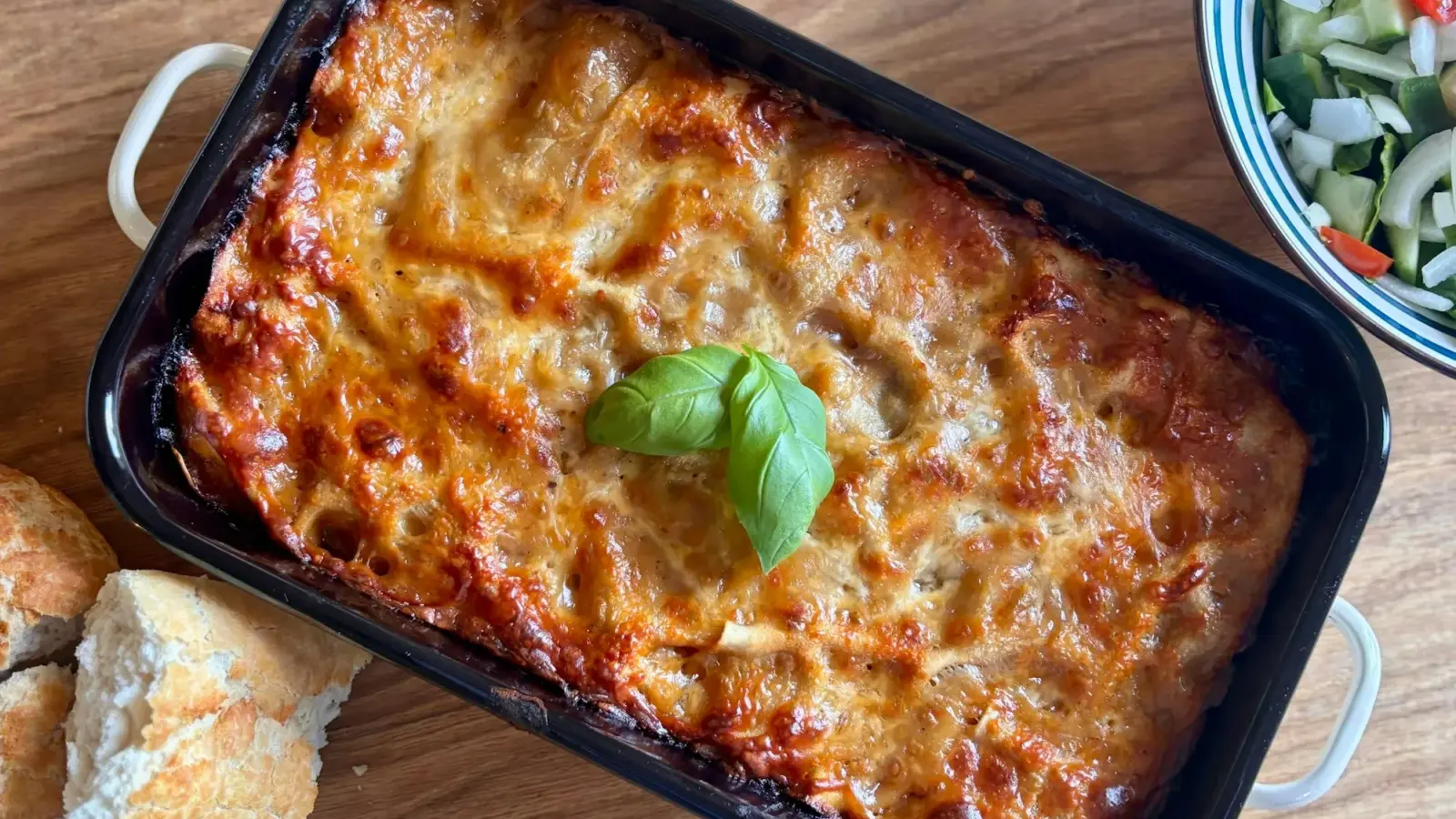
Good baked ziti is saucy in the middle, browned on top and firm enough to cut into squares. Three things get you there: pasta pulled from the pot 2 minutes before al dente, more sauce than looks sensible (about 6 cups, or 1.4 liters, for a pound of pasta), and a bake under foil at 375°F (190°C) before the cheese browns uncovered.
The recipe below fills a 9×13-inch (23×33 cm) dish and serves 8. It builds a quick marinara, with Italian sausage if you like, and it can be assembled a day ahead.
Why baked ziti dries out, and how to prevent it
Pasta keeps drinking liquid in the oven. Ziti that goes into the dish fully cooked spends another 40 minutes absorbing sauce, turns soft and leaves the casserole tight and pasty. The fixes:
- Undercook the pasta by 2 minutes so it finishes cooking in the sauce. America’s Test Kitchen’s baked ziti goes further, boiling the pasta only until it starts to soften and adding extra sauce for it to absorb.
- Use enough sauce: about 6 cups (1.4 liters) per pound (454 g) of pasta. Sauced ziti should look looser than you would serve it on a plate.
- Cover every tube. Pasta poking out of the top layer turns leathery, so the last of the sauce goes over the surface before the cheese.
- Bake under foil first to hold in steam while the center heats, then uncover to brown.
Tip: Save 1 cup (240 ml) of pasta water before draining. A few splashes loosen sauced pasta that looks tight, and America’s Test Kitchen’s make-ahead baked ziti with sausage, reprinted by Food Republic, uses it the same way to keep a refrigerated casserole from drying out.
Ingredient notes and substitutions
Ziti, penne or rigatoni
Ziti are smooth tubes cut straight across; penne are cut on the diagonal. Either works. Ridged (rigate) versions grip a little more sauce, and rigatoni is a fine stand-in.
The sauce, with or without sausage
A quick marinara of onion, garlic, oregano and two 28-ounce (794 g) cans of crushed tomatoes, simmered for 15 to 20 minutes, is all this dish needs; the oven finishes the reducing. Our homemade marinara for pasta and pizza works too, but one batch makes about 4 cups, so cook a batch and a half to get the 6 cups (1.4 liters) this dish needs. The can-buying advice in our guide to homemade pizza sauce applies here too: taste a couple of brands and buy the brightest one.
For a meatier ziti, brown 1 pound (454 g) of sweet or hot Italian sausage before the onion. It needs to reach 160°F (71°C), the figure for ground meat and sausage on the FoodSafety.gov minimum internal temperature chart; thorough browning followed by 15 to 20 minutes of simmering in the sauce takes it well past that.
Ricotta, with or without egg
Whole-milk ricotta gives the creamiest layer; if it looks wet, drain it in a fine strainer for 15 to 30 minutes.
The egg is a structural choice. With it, the ricotta sets into a layer that holds when you slice; without it, the cheese stays softer and melts into the pasta around it. Neither is wrong.
Low-moisture mozzarella, not fresh
Buy the firm, vacuum-packed block. Under the federal standards of identity, low-moisture mozzarella is more than 45 and up to 52 percent water by weight, while regular (high-moisture) mozzarella, the soft kind usually sold fresh, runs above 52 and up to 60 percent. That extra water ends up as puddles in the dish. Our rundown of the best cheeses for pizza explains why the same block wins on a pie.
Shred it yourself: America’s Test Kitchen’s recipe warns that pre-shredded cheese doesn’t melt well.
Layering, baking and resting
A thin coat of sauce on the bottom of the dish keeps the pasta from sticking. The ricotta goes on in rough dollops between two layers of pasta, with half the mozzarella over it; the reserved sauce, the rest of the mozzarella and the Parmesan cover the top.
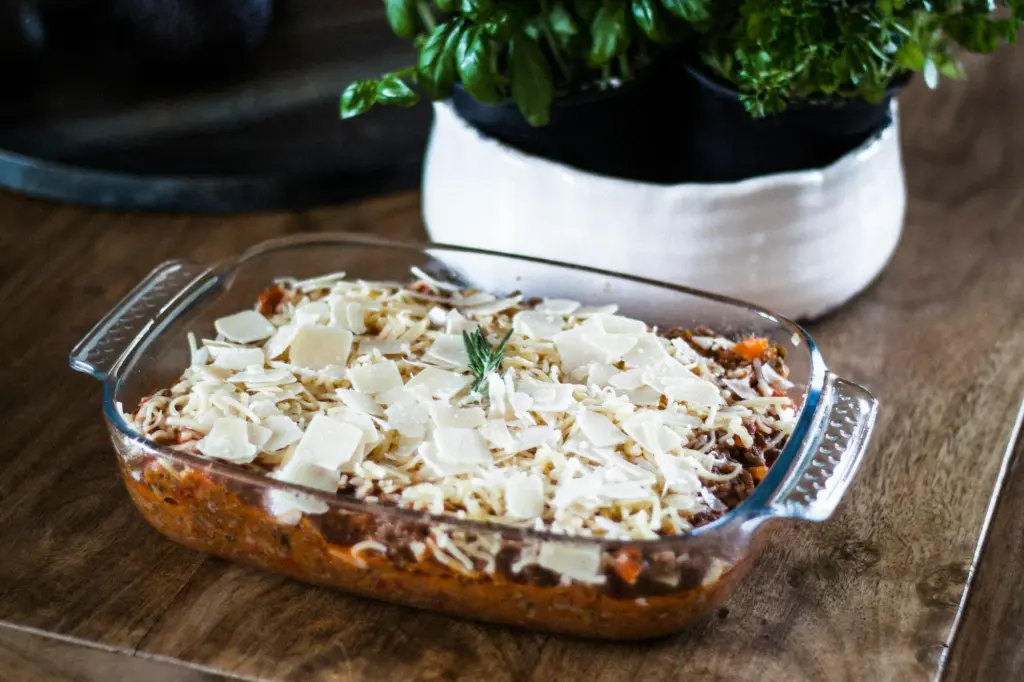
Bake at 375°F (190°C): 20 to 25 minutes under lightly oiled foil, then 20 to 25 minutes uncovered. It’s done when the edges bubble hard, the cheese is spotted with brown and an instant-read thermometer in the center reads 165°F (74°C), the FoodSafety.gov target for casseroles with or without meat. That also covers the egg in the ricotta, since egg dishes need 160°F (71°C).
Then wait 10 to 15 minutes. Straight from the oven, the cheese and sauce are fluid and the squares slump; a short rest lets them set.
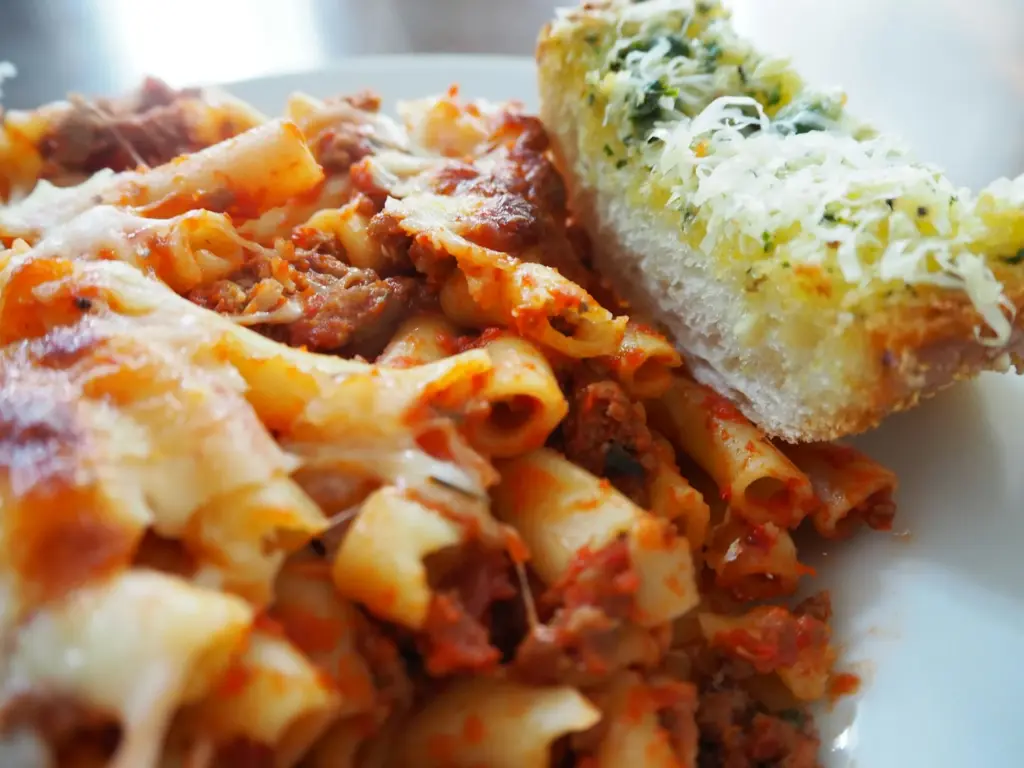
Classic Baked Ziti with Ricotta and Mozzarella
Ziti cooked 2 minutes shy of al dente, a quick marinara (sausage optional), ricotta and low-moisture mozzarella, baked at 375°F until bubbling and browned.
- Prep
- 30 min
- Cook
- 1 hr 15 min
- Rest before cutting
- 15 min
- Total
- 2 hr
- Yield
- One 9x13-inch (23x33 cm) casserole
- Serves
- 8
- Oven
- 375°F (190°C), rack in the middle
Ingredients
Sauce
Pasta
Ricotta layer
Cheese and assembly
Equipment
- Large pot (6 quarts/5.7 liters or larger)
- Large deep skillet or Dutch oven
- Colander
- Box grater
- 9x13-inch (23x33 cm) baking dish, ideally 2½ to 3 inches (6 to 7.5 cm) deep
- Aluminum foil and a rimmed baking sheet
- Instant-read thermometer
Instructions
- Heat the oven and the water Heat the oven to 375°F (190°C) with a rack in the middle. Bring the water and pasta salt to a boil in the large pot.
- Brown the sausage (optional) Heat 1 tablespoon (15 ml) oil in the skillet over medium-high heat. Brown the sausage, breaking it into small pieces, until cooked through to 160°F (71°C), 6 to 8 minutes.
- Soften the aromatics Over medium heat (using the 3 tablespoons/45 ml oil if you skipped the sausage), cook the onion until soft and translucent, 6 to 8 minutes. Add the garlic, pepper flakes and oregano and stir until fragrant, about 1 minute.
- Simmer the sauce Add the tomatoes and salt and simmer gently, uncovered, until slightly thickened but still loose, 15 to 20 minutes. Stir in the basil and season to taste. You should have about 6 cups (1.4 liters), or 7 with sausage.
- Mix the ricotta layer Stir together the ricotta, egg (if using), ½ cup (50 g) Parmesan, parsley, salt and pepper.
- Undercook the pasta Boil the ziti 2 minutes less than the package's al dente time; it should bend but stay firm at the center. Reserve 1 cup (240 ml) cooking water and drain.
- Sauce the pasta Return the pasta to the pot. Set aside 3 cups (720 ml) sauce and stir the rest into the pasta, adding pasta water a splash at a time (up to ½ cup/120 ml) until loose and glossy.
- Build the bottom layer Spread 1 cup (240 ml) reserved sauce in the baking dish. Add half the pasta, dollop and roughly spread the ricotta mixture over it, then scatter on half the mozzarella.
- Build the top layer Add the remaining pasta, spread the last 2 cups (480 ml) sauce over it so no tubes show, and top with the remaining mozzarella and Parmesan.
- Bake covered Cover tightly with lightly oiled foil, set the dish on the rimmed baking sheet and bake at 375°F (190°C) until the edges bubble, 20 to 25 minutes.
- Uncover and brown Uncover and bake until the cheese is spotted with brown, the edges bubble vigorously and the center reads 165°F (74°C), 20 to 25 minutes. If the top browns first, cover it loosely.
- Rest and serve Rest 10 to 15 minutes so the layers set, then cut and serve.
Notes
- A 2-inch (5 cm) deep 9x13 dish will be full to the brim; bake any extra in a small dish.
- Make ahead: cool the sauce and pasta 30 minutes, add an extra ½ cup (120 ml) pasta water, assemble, cover and refrigerate up to 24 hours. Bake covered 35 to 45 minutes, then uncovered 15 to 20, to 165°F (74°C) in the center.
- Freeze baked or unbaked, wrapped airtight, for 2 to 3 months for best quality; thaw in the refrigerator. Refrigerate leftovers within 2 hours, eat within 3 to 4 days and reheat to 165°F (74°C).
Common baked ziti mistakes
- Fully cooked pasta: it goes soft and soaks up the sauce.
- Too little sauce: if the sauced pasta looks right for a plate, it is too dry for the oven.
- Fresh mozzarella: it releases water and leaves a soupy bottom.
- Cutting it right away: the layers run together.
Variations
- Meatballs: tuck small cooked meatballs from our spaghetti and meatballs recipe between the layers.
- Spinach: stir a 10-ounce (283 g) box of thawed frozen spinach, squeezed very dry, into the ricotta mixture.
- Two pans: split the recipe between two 8-inch (20 cm) square pans, bake one and freeze the other. Smaller pans heat through faster, so check the center temperature early.
Like classic chicken Parmesan, baked ziti runs on red sauce, mozzarella and Parmesan, so one big pot of sauce can cover both dinners. For a pizzeria-style spread, add a basket of homemade garlic knots.
Make-ahead, freezing and reheating
Assemble up to 24 hours ahead
Cool the sauce and pasta for about 30 minutes, stir an extra ½ cup (120 ml) of pasta water into the pasta (it keeps absorbing in the fridge), assemble, cover tightly and refrigerate for up to 24 hours. America’s Test Kitchen’s make-ahead version also stores the ricotta separately and dollops it on when the foil comes off, because ricotta kept inside the casserole turned watery and grainy in their testing. To follow suit, refrigerate the ricotta mixture in its own container and leave out the egg, since the dollops get a shorter bake.
Bake the cold casserole at 375°F (190°C), covered for 35 to 45 minutes and uncovered for 15 to 20, until the center reaches 165°F (74°C). Glass dishes can crack with sudden temperature changes, so let a glass dish stand on the counter while the oven heats.
Freezing
Baked ziti freezes well, baked or unbaked. Use a metal or foil pan, chill the casserole in the refrigerator first, then wrap it airtight. Freezer times are about quality rather than safety: the FoodSafety.gov storage chart gives 2 to 3 months for baked casseroles made with eggs, and Texas A&M AgriLife Extension’s Dinner Tonight program suggests up to 2 months for assembled ziti.
Thaw it in the refrigerator for 24 to 48 hours and bake as for the make-ahead casserole. Baking from frozen works but is slow: plan on about 1½ hours covered plus 15 to 20 minutes uncovered, and trust the thermometer over the clock.
Leftovers
Refrigerate leftovers in shallow containers within 2 hours (1 hour if the room is above 90°F/32°C) and eat them within 3 to 4 days. Reheat portions in the microwave, covered, with a spoonful of water or sauce, or larger amounts under foil in a 350°F (175°C) oven. N.C. Cooperative Extension’s leftovers guidance calls for 165°F (74°C) all the way through, including for casseroles.
Where baked ziti comes from
Ziti are a southern Italian pasta with a wedding story attached. The Takeout traces the name to maccheroni della zita, “bride’s pasta,” served at weddings. Other references translate the word as either “brides” or “grooms,” so treat the story as tradition rather than settled history.
Italy has its own baked pastas, pasta al forno, but the version layered with red sauce, ricotta and mozzarella is generally considered an Italian-American creation, and nobody has a documented claim to inventing it.
Its natural setting is the big family table. In a 2014 Saturday Evening Post story on Sunday gravy, food author John Mariani describes how poor southern Italian immigrant women “suddenly found an abundance of cheap food in the U.S.” and recalls Sundays spent traveling between relatives’ homes. There’s no reliable date for when baked ziti joined that spread, but it fits: pantry ingredients, one pan, eight servings, made a day ahead if needed.
Sources
- Baked Ziti, America's Test Kitchen (Cook's Illustrated)
- Baked Ziti With Italian Sausage Recipe (from The Make-Ahead Cook, America's Test Kitchen), Food Republic
- Safe Minimum Internal Temperature Chart for Cooking (FoodSafety.gov chart, last reviewed Dec. 16, 2022), FoodSafety.gov, hosted by Virginia Department of Health
- Enjoy Your Thanksgiving Leftovers Safely: Expert Tips From NC State's Safe Plates Program, N.C. Cooperative Extension, Rutherford County Center (Sheri Ledford, Nov. 6, 2024)
- Keep Food Safe: Guide to Refrigerator Storage Periods (reproduces the 2023 FoodSafety.gov Cold Food Storage Chart), University of Delaware Cooperative Extension (Aug. 2025)
- Are You Storing Food Safely?, U.S. Food and Drug Administration
- Baked Ziti (freeze, thaw and bake instructions), Dinner Tonight, Texas A&M AgriLife Extension
- 21 CFR 133.156 - Low-moisture mozzarella and scamorza cheese, Legal Information Institute, Cornell Law School
- 21 CFR 133.155 - Mozzarella cheese and scamorza cheese, Legal Information Institute, Cornell Law School
- Ingredient Weight Chart, King Arthur Baking
- Italian-American Menu Items That Aren't From Italy At All (Anita Surewicz, Jan. 7, 2025), The Takeout
- Sunday Gravy (Dan Freedman, April 17, 2014), The Saturday Evening Post
- Ziti (citing Oretta Zanini De Vita, Encyclopedia of Pasta), Wikipedia