How New York-Style Pizza Became an American Icon
From Neapolitan bakers on Spring Street to the gas-oven slice shop, and why the famous 1905 "first pizzeria" date doesn't hold up.
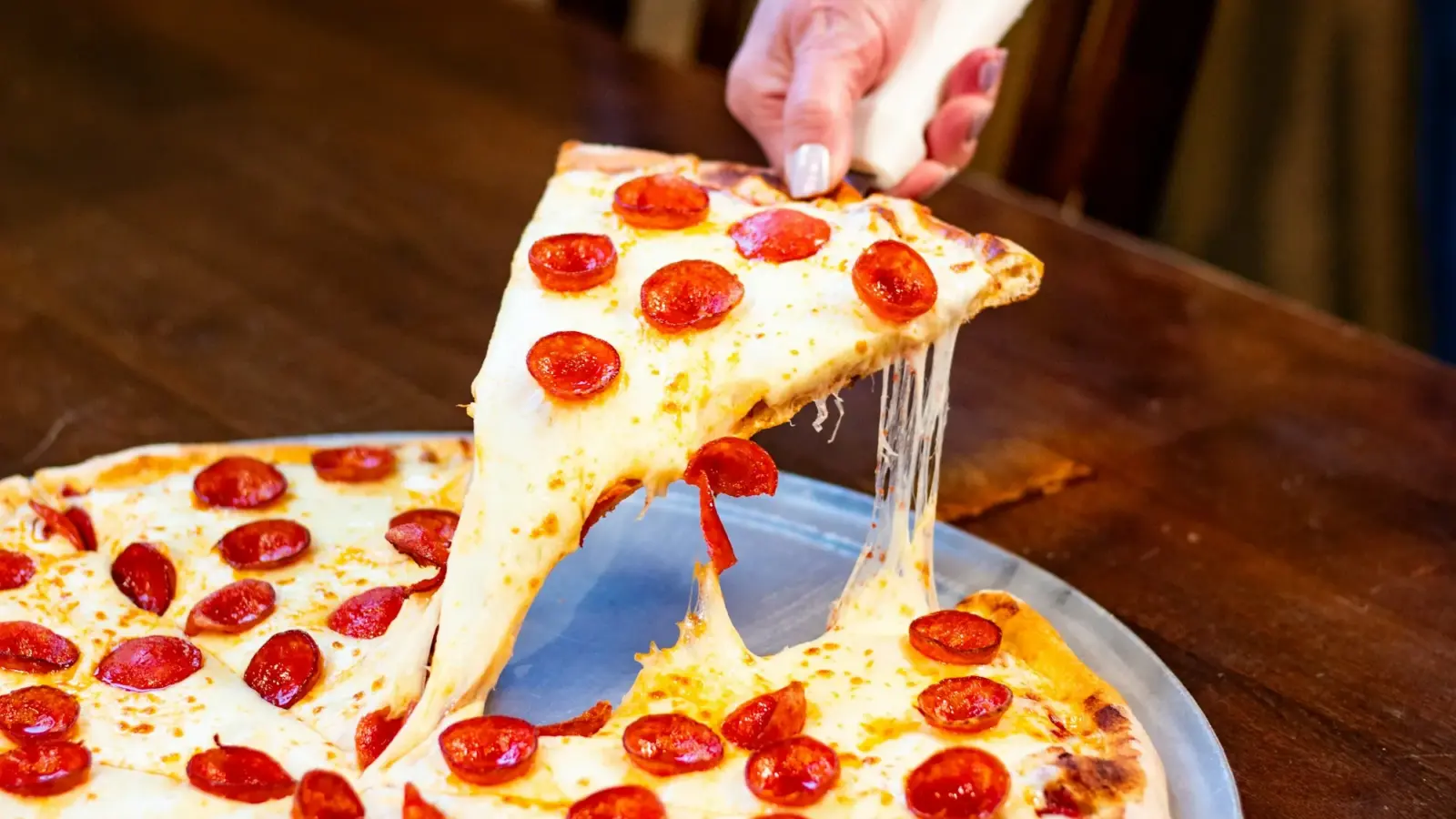
New York-style pizza became an American icon in three moves. Neapolitan immigrants opened bakery-pizzerias in Lower Manhattan from the 1890s and sold whole pies out of coal-fired ovens. Gas-fired deck ovens arrived in the 1940s and made it practical to sell pizza by the slice. After World War II, the slice shop and then the national chains turned an immigrant food into an everyday American meal.
The famous origin story, that Gennaro Lombardi opened America’s first licensed pizzeria on Spring Street in 1905, is the part that has not held up. The records point to older shops, a forgotten baker named Filippo Milone and a messier road from Little Italy to the national menu.
At a glance
- Earliest documented pizzeria: Giovanni Albano’s shop at 59½ Mulberry Street, operating by 1894 according to city directories found by researcher Peter Regas.
- The 1905 claim: Regas found no trace of the license. Lombardi arrived in New York in November 1904, aged 17, and bought the Spring Street pizzeria in 1908; the shop most likely dates to 1898.
- Coal-oven era: Early pizzerias sold whole pies from coal-fired masonry ovens. Totonno’s (1924), Patsy’s (1933) and John’s all trace their roots to it.
- The slice: Gas ovens, introduced in the early 1940s, made selling by the slice a viable business, and dedicated slice shops spread after the war.
- National reach: About 1 in 8 Americans ate pizza on any given day in USDA survey data from 2007–2010.
Pizza arrived with Neapolitan bakers
Pizza came to New York the way most immigrant food does: with people who already knew how to make it. The early pizza makers that independent researcher Peter Regas has traced through city directories, immigration files and Italian-language newspapers came largely from Naples and the surrounding Campania region.
The earliest pizzeria he has verified belonged to Giovanni Albano, who had owned a pizzeria in Naples and was operating one at 59½ Mulberry Street by 1894. Regas, who publishes his evidence at pizzahistorybook.com, hedges even that date. There are hints of earlier pizza makers, but the further back he looks, the more circumstantial the evidence gets, and the blurrier the line between a street peddler, a bakery and a true pizzeria.
These were not restaurants in the modern sense. Directories listed the same men as grocers, bakers and delicatessen owners, and a pizza maker could turn up under a heading like “Bakers, Pie.” One shop might sell bread, groceries and pizza from the same oven and the same counter.
The central figure in Regas’s research is Filippo Milone, born in Piano di Sorrento, near Naples, in 1862. Regas believes Milone established pizzerias at six or more New York locations between 1894 and 1922, often opening a shop and then handing it off, a habit that led Smithsonian to cast him as pizza’s Johnny Appleseed. Three of those locations later became famous under other names: Pop’s in Brooklyn, long since closed, and two that still operate, John’s and Lombardi’s. Milone died in 1924 and was buried in an unmarked grave in Queens.
The Lombardi’s 1905 story, and why it doesn’t hold up
For most of the last century, American pizza had an official birthday and an address: 1905, Spring Street. As of October 2026, Lombardi’s own website still bills it as America’s first pizzeria, established in 1905, and credits Gennaro Lombardi with developing New York-style pizza.
Regas went looking for the 1905 license and never found it. What he did find, as Smithsonian reported in 2019, were Gennaro Lombardi’s birth and immigration records. Born in Naples in August 1887, he arrived in New York in November 1904, at 17, with his occupation listed as laborer. That is a thin résumé for someone supposedly running a licensed business a few months later.
The shop was older than his time there. Regas concludes that Milone very likely opened 53 Spring Street as a combined pizzeria and grocery in the summer of 1898. A 1902 business directory lists a later owner, Giovanni Santillo, as a pie baker at the address, and by August 1904 Italian-language newspaper ads show Santillo running it as the Antica Pizzeria Napoletana, months before Lombardi stepped off the boat.
Lombardi may well have worked for Santillo after he arrived. He bought the business in the fall of 1908, at 21, when Santillo went back to Italy, and held it only briefly. Around 1918 he bought it back from Francesco D’Errico, a relative by marriage, and ran it until his death in 1958. That is a long, real run at the center of New York pizza, and nothing in the research takes it away. What the evidence does not support is the word “first.”
How 1905 became the official date
Regas also compiled a timeline of how the story was told in print. A 1953 Collier’s article by Herbert Mitgang placed the first American pizzeria at 53½ Spring Street around 1895 and said Lombardi bought it in 1905 for $200. Three years later, Mitgang wrote in The New York Times that “Nobody has disputed his claim to having the oldest pizzeria in the United States.”
The details kept drifting. Evelyne Slomon’s 1984 The Pizza Book had Lombardi opening the shop himself in 1905, and the earliest mention of a business license in Regas’s timeline is a 1996 Pizza Today article, also by Slomon. Repetition did the rest.
Note: Old directories, newspaper ads and immigration records can’t always prove who made pizza where, and Regas hedges several of his own conclusions as probable rather than proven. Treat any “first pizzeria” date, including the ones above, as the best current evidence rather than settled fact.
The coal-oven pizzerias and the whole pie
New York’s earliest pizzerias baked in giant coal-fired masonry ovens, used first for bread and later for pies. Food Republic puts their heat as high as 800 to 1,000°F (about 425–540°C). That kind of heat chars and blisters the crust, and the pizza was sold the way it came out of the oven: whole.
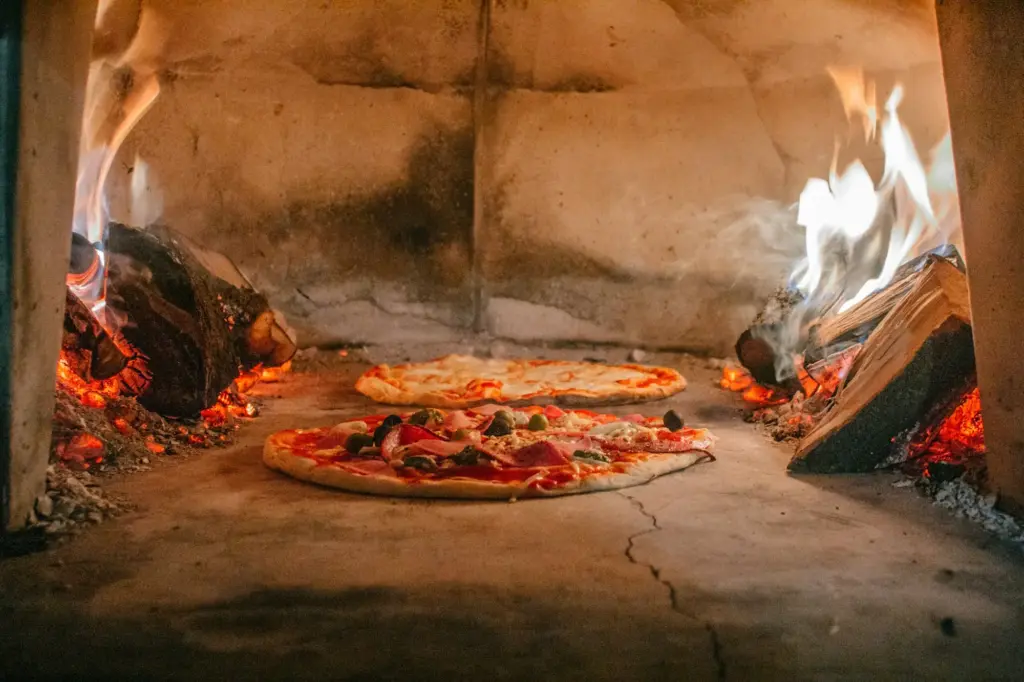
Three names from this era still anchor the story, each with its own tangle of dates.
- John’s of Bleecker Street. John’s has long given 1929 as its opening year, but Scott Wiener, who runs Scott’s Pizza Tours, dates it to 1916, possibly earlier, when Milone, the uncle of John Sasso’s wife, founded it as Pizzeria Port’Alba. Regas found Milone taking over a bakery at 175 Sullivan Street in 1915. The pizzeria moved to Bleecker Street in 1938 and became John’s Pizzeria Port Alba.
- Totonno’s. The Coney Island pizzeria on Neptune Avenue describes itself as family-owned since 1924. Its founder, Antonio “Totonno” Pero, had worked for Lombardi, according to his granddaughter’s account in Vice. He is the man standing beside Lombardi in the famous photograph that Regas dates to the fall of 1908.
- Patsy’s. Pasquale Lancieri opened his first shop in Harlem in 1933, according to the Patsy’s Pizzeria website. His nephew Patsy Grimaldi would later carry the coal-oven style to Brooklyn.
Which of these are still worth the trip, and what sets each apart today, is the subject of our guide to historic pizzerias in New York City.
The gas deck oven made the slice possible
The New York slice owes more to an oven than to any recipe.
Gas-fired pizza ovens were introduced in the early 1940s, according to Wiener, and they behave very differently from coal. They are heated indirectly and run much cooler, around 500 to 550°F (260–290°C) in a typical slice shop by Food Republic’s figures, so a pie takes longer to bake. Food Republic credits the gas deck oven with the softer, more foldable slice that New Yorkers now treat as standard.
The bigger shift was in the business. Smithsonian, summarizing Ed Levine’s history of the slice for Serious Eats, credits Ira Nevin, a GI and oven repairman, with designing the first gas-powered pizza oven, which freed pizzeria owners from wood- and coal-fired ovens that were difficult to run and maintain. Bakers Pride, an oven company founded in the Bronx in the mid-1940s, credits itself with inventing the modern production pizza oven.
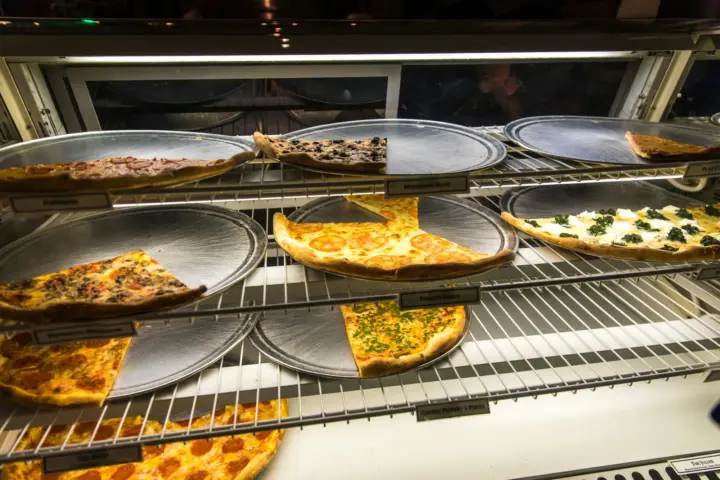
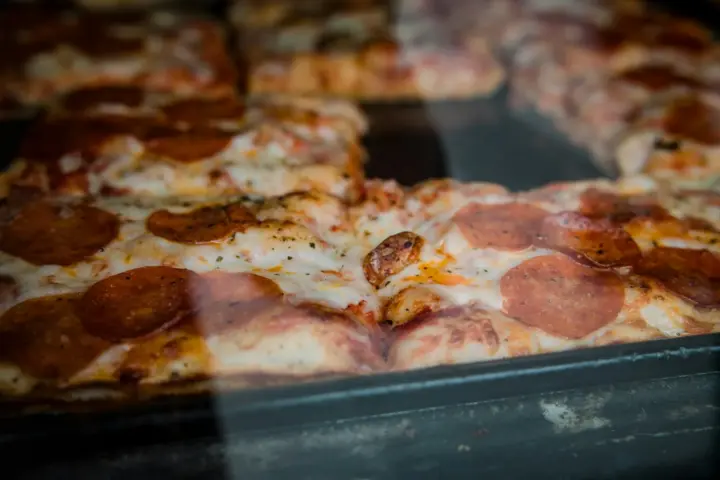
Wiener’s view is that gas ovens made pizza by the slice a viable business, and the reason is practical. As Food Republic explains, the gentler bake leaves more moisture in the crust, so a pie can sit in the display case and be reheated a slice at a time without turning dry or hard. A shop can bake whole pies ahead and sell them one piece at a time.
After the war: the slice shop and the fold
Before World War II, pizza was mostly a neighborhood food in Italian communities. Smithsonian puts it bluntly: few people in the mainstream knew what it was until after the war. The usual explanation for what changed, which Smithsonian repeats from Levine, is that service members stationed in Italy came home with a taste for it. That is plausible but hard to measure, and it coincided with the new ovens that made a cheap slice possible.
Food Republic dates the spread of dedicated slice shops to the years after the war. The format suited the city: cheap, fast, eaten at a counter or on the sidewalk. Writing in 2015, Wiener noted that old-school places like John’s, Lombardi’s and Totonno’s don’t sell slices, while pizzerias that opened after the war generally do.
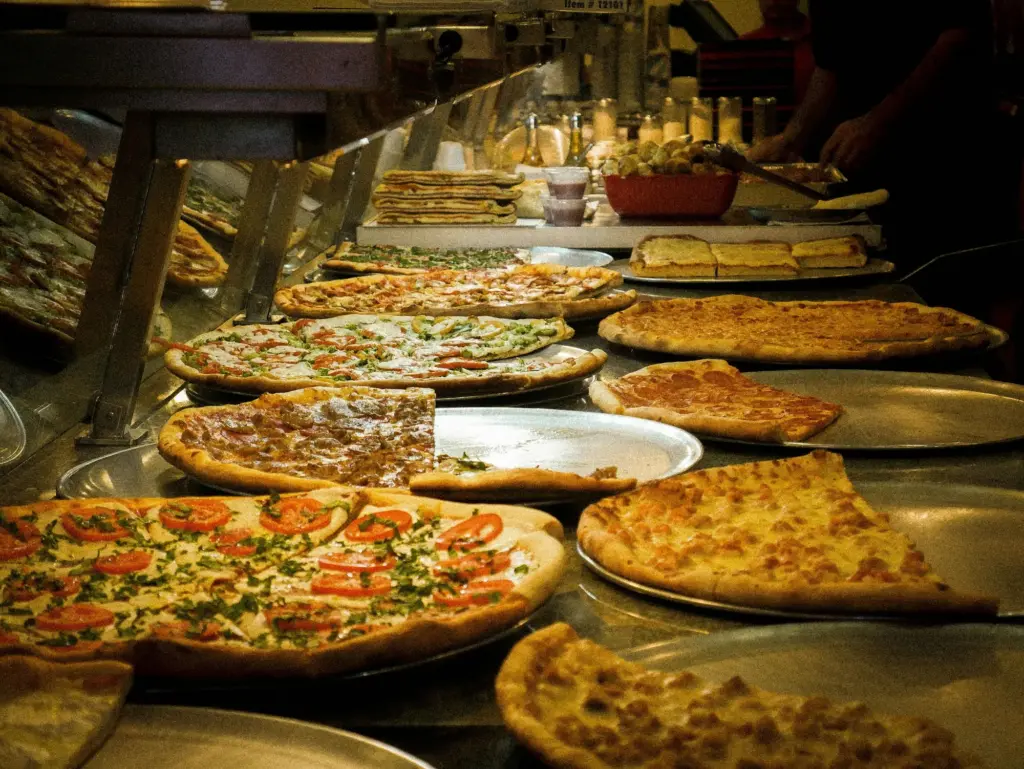
Patsy’s website goes further and credits Lancieri with inventing pizza by the slice. That is the pizzeria’s claim, not a documented first, and the idea is older than New York anyway: Wiener points to an 1858 etching by Filippo Palizzi that shows a Naples street vendor selling pizza by the slice.
The fold has a similar backstory. Neapolitans were folding pizza before New Yorkers made a habit of it, and our comparison of New York and Neapolitan pizza covers that history alongside the differences in flour and oven heat. What New York added was visibility: Wiener credits 1960s movies and television with cementing the link between the slice and the city.
The counter, the shakers, the reheated slice handed over on a paper plate: our anatomy of the classic neighborhood pizzeria breaks down how that format works.
How pizza became a national food
By Smithsonian’s account, the returning GIs and the gas oven together set off the first American pizza boom, which led to the early pizza chains of the 1950s. One of the best known came from Kansas, not New York. In 1958, brothers Dan and Frank Carney, both Wichita University students, opened the first Pizza Hut at the corner of Bluff and Kellogg; Wichita State University now keeps the original building as a museum.
Historian Carol Helstosky’s Pizza: A Global History (Reaktion Books, 2008) follows that arc. As its publisher summarizes it, pizza followed Italian immigrants to America in the 20th century, became the nation’s most popular dish and fueled the rise of fast-food companies such as Pizza Hut and Domino’s.
Federal survey data bear that out. In a 2014 USDA analysis of national dietary data from 2007–2010, 13% of Americans aged 2 and older ate pizza on any given day, about 1 in 8. Among children aged 6 to 11 and teenagers aged 12 to 19, the figure was about 22%.
Plenty of that pizza is a chain delivery pie or a regional style, and New York has no monopoly on good pizza. But the New York slice was an early model of pizza as cheap, fast, everyday food, and the “New York-style” label travels well beyond the five boroughs. Our look at pizza culture in Albany follows the style up the Hudson to the state capital.
The coal-oven revival
The slice shop won the second half of the 20th century, but the coal oven never went out. Food Republic notes that coal ovens still fire pies at some of Manhattan’s oldest pizzerias, and in the 1990s they staged a comeback that started in Brooklyn.
In 1990, Patsy and Carol Grimaldi converted an old hardware store into a classic coal-fired pizzeria. Wiener credits it with starting a wave of coal-oven revivalists, including Lombardi’s reopening in 1994 and the expansion of John’s and Totonno’s a few years later.
The Grimaldis sold Grimaldi’s in 1998. In 2012 they returned to the neighborhood with Juliana’s, which turned out the same style of coal-fired pie and which Patsy Grimaldi owned until his death in 2025. In September 2026, Wiener reported that the intersection of Old Fulton and Front streets would be co-named Patsy & Carol Grimaldi Way, part of a city move to co-name 103 streets and public places.
What the history explains about the pizza itself
Set the disputed dates aside and the history explains the pie. A thin center, a modest chewy rim and a crisp underside that still bends are what you get from strong dough baked for several minutes on a gas deck: sturdy enough to hold in one hand, cheap enough to sell by the piece.
It is also why the style works so well at home. A home oven at 500–550°F (260–290°C) with a preheated steel or stone runs in the same range as a slice shop’s gas deck, far below a coal or wood oven. Our step-by-step New York-style dough lays out the formula in baker’s percentages, and the classic New York cheese pie walks through the bake.
Sources
- The Father of American Pizza Is Not Who We Thought He Was (Jason Daley, Feb. 8, 2019), Smithsonian Magazine
- Who Established the Famous Pizzeria at 53 Spring Street? (Peter Regas, Sept. 30, 2021), Pizza History Book (Peter Regas)
- Who was Gennaro Lombardi? (Peter Regas, Feb. 5, 2019, updated 2021), Pizza History Book (Peter Regas)
- Lombardi's Pizzeria Origin Story: A Media Timeline (Peter Regas, updated May 26, 2022), Pizza History Book (Peter Regas)
- Introduction & Summary (Peter Regas, Jan. 14, 2019), Pizza History Book (Peter Regas)
- Thoughts on the Origins of Pizzerias in America and Chicago (Catherine Lambrecht, Feb. 11, 2021), Culinary Historians of Chicago
- Lost Forefathers of Pizza in America Discovered (Feb. 5, 2019), U.S. Pizza Museum
- When did we start folding pizza? (Scott Wiener, Nov. 29, 2015), Scott's Pizza Tours
- Historic Pizzeria Benches at Auction (Scott Wiener, July 21, 2026), Scott's Pizza Tours
- Patsy & Carol Grimaldi Street Co-naming (Scott Wiener, Sept. 26, 2026), Scott's Pizza Tours
- The Difference Between NYC's 4 Most Common Styles Of Pizza (Andrea Carlo, Aug. 1, 2026), Food Republic
- About Bakers Pride, Bakers Pride
- Lombardi's: America's First Pizzeria, Est. 1905 (restaurant website), Lombardi's Pizza
- Totonno's Pizzeria Napolitana: Family Owned Since 1924 (restaurant website), Totonno's Pizzeria Napolitana
- About (Patsy's Pizza UWS, restaurant website), Patsy's Pizzeria
- Pizza Hut Museum, Wichita State University
- Pizza: A Global History (Carol Helstosky, Edible series, 2008), publisher's page, Reaktion Books
- Consumption of Pizza: What We Eat in America, NHANES 2007-2010 (Dietary Data Brief No. 11, Feb. 2014), USDA Agricultural Research Service, Food Surveys Research Group
- The Untold Story of How My Grandfather Brought Pizza to America (Antoinette Balzano, as told to Brad Cohen, Feb. 19, 2017), Vice